
Received in october 2013, a free-form cab of grayish white rock with bright blue orbs (such kind of raindrop) splashed onto. Such material has not been seen yet and it appeared to be an extremely interesting rock for cabbing, visually very attractive. Gemologically speaking, it was also challenging to identify such unusual material. What was that?
The received sample had just a blue orb on the top and it is not the cab shown in figure 1, but the later better shows what material looks like. Anyhow the received cab was sliced for this study and it does no longer exist as is (see figure 2). The material is quite homogenous and it is finely grained, white to grayish white and gray to black with the blue orbs ranging from a few millimeters up to about one centimeter in diameter.
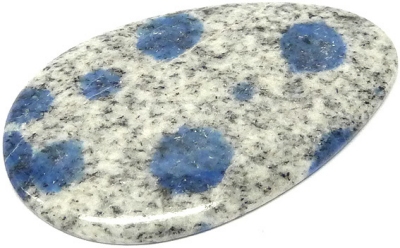 Figure 1. 31.37 ct cab of the new attractive material.
| Shape | flat free form cab |
| Size | 43.5 x 27.4 x 3.2 mm |
| Color | blue, white, black, some brown and green |
| Lustre | sub-vitreous |
| Weight | 31.37 ct (figure 1 sample) |
| SG | 2.62 (figure 1 sample) |
| SWUV | inert |
| LWUV | inert |
| Magnetic susceptibility | very weak with N52 ( < 4%) |
Table 1. Observational and measured properties
The received sample was the rectangular cab photgraphied on figure 2. Only the back is visible but this is to give an overall picture to locate the other points of interest. The material is grained of white, gray, brown and black materials along with some blue and green materials. The blue orb from the top is deep enough to reach the cab's back, so the color is not a 'stain' at the material surface. The two arrows on the figure 2 show a green crystal (arrow #1) and a blue crystal in the fringes of the blue orb (arrow #2).
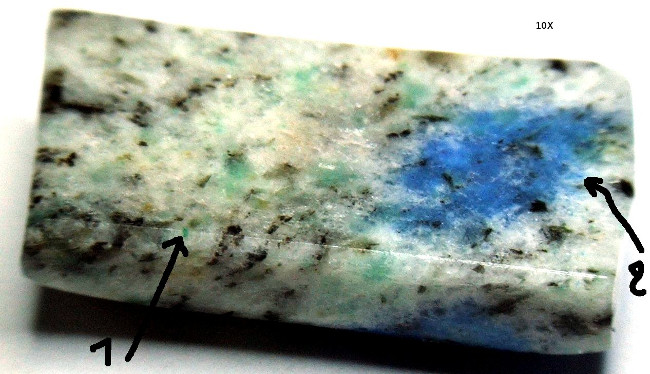 Figure 2. The cab's back used for the spectroscopy studies shows the fine grained structure of the material and the location of a blue crystal right to the blue orb (arrow 2) and that of a green crystal (arrow 1).
A closer view of the area pointed by the arrow #2 is available in figure 3. The blue 'stains' are present along mineral grain boundaries, within tiny fractures, and as a 'dye' penetrating the grains. Many minute blue crystals are spread across and around the blue orb but they do not exist in the remaining part of the cab. Details about one of the biggest blue crystals are shown in figure 4, crystal is the one having the focus in figure 3. It is difficult to try to identify the crystallographic forms. The figure 5 shows the green crystal pointed by the arrow #1, identifying the crystallographic form is here even less evident.
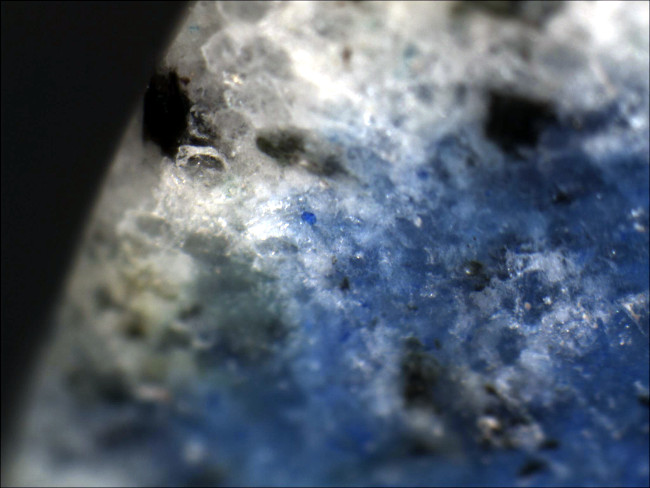 Figure 3. A closer view of the blue crystal located on the side of the blue orb. The later seems to be the result of a blue color diffused in the whitish to colorless material. Many minute blue crystals are spread across and around the blue orb but they do not exist in the remaining part of the cab.
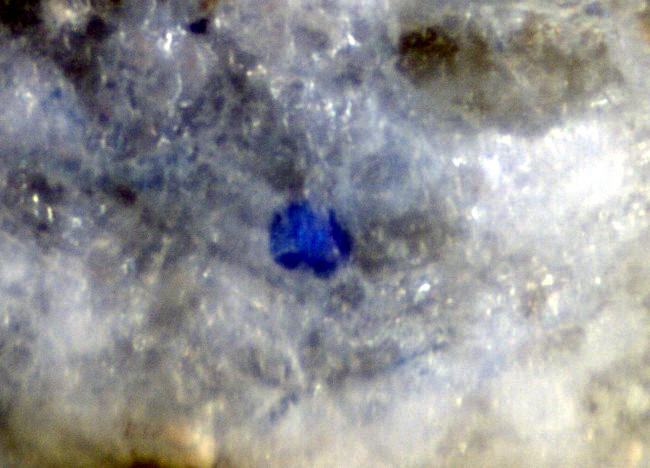 Figure 4. The blue crystal in its host (~80x).
 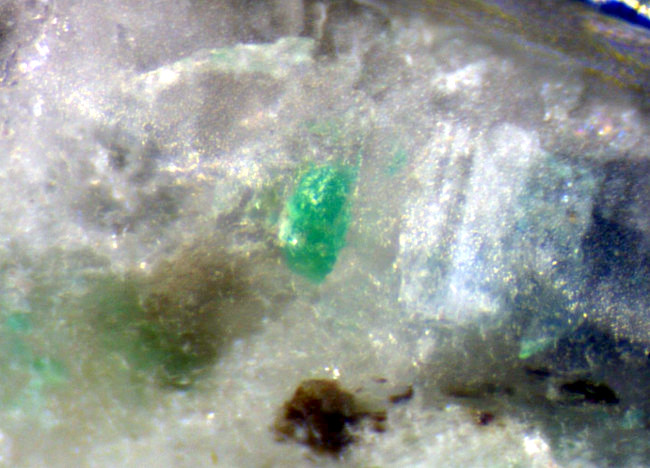 Figure 5. The green crystal in its host (~80x).
 Infrared reflectance spectroscopy:
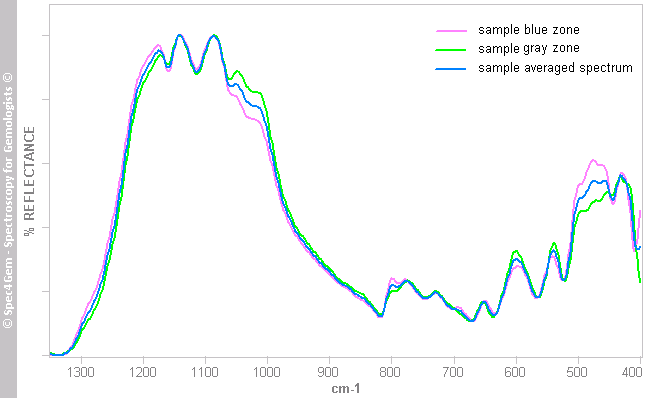 Figure 6. Averaged IR reflectance spectra of the blue orb (in pink), the grayish-white part of the cab (in green) and the averaged spectrum of the two later. There is no distinct feature between the blue and gray zones spectra, averaging both gives a spectrum with all reflection bands.
Since the rock structure is grained, we expect to find several materials in this this rock and possibly the material causing the blue color. Three spectra were acquired from the blue orb and two from the grayish white zone, each of them acquired from a slighly shifted position from the precedent one. All spectra of the blue orb (zone) do not significantly differ, all showing an idendentical pattern, as well as for all spectra of the grayish white zone. Despite this, all spectra of a zone are averaged to produce the two spectra 'sample - blue zone' and 'sample - gray zone' as identified in figure 6. There is no very distinct feature between the blue and white zones spectra. Averaging both spectra gives a spectrum where all reflection bands are present. Note that this third spectrum is similar in all points to the two later.
The averaged spectrum is used to search matches in the gemstone spectra database which does not include rocks yet. Two close matches are found, one for quartz and one for K-feldspar var. microline, the corresponding spectra are resized for better clarity and they are plotted in figure 7. The averaged spectrum of the sample is annotated with the bands assignements. Another experiment is to sum both quartz and K-feldspar spectra, the result is a spectrum rather close to the sample spectrum, not idealy matching but close, the related spectrum is not displayed in figure 7.
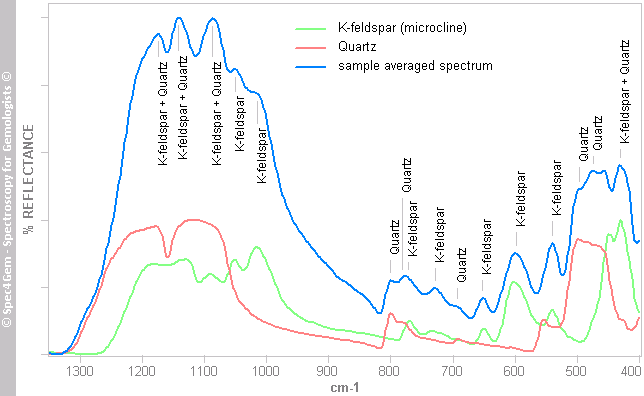 Figure 7. The automatic spectrum matching search in the spectra database gives two matching spectra, quartz and microcline a K-feldspar which are depicted in red and green respectively (normalized for better display). The reflection bands of both are annoted in the cab's spectrum (blue). Summing the quartz and K-feldspar spectra gives a spectrum very close to that of the cab.
At this step, we have a rock which is mainly composed of quartz and K-feldspar, which is finely grained, thus granite rock is the ideal candidate even if biotite has not been detected in spectra. Since then, some granite rock spectra were added to the database, one of them is plotted in figure 8 to compare it to the sample spectrum, the match is almost ideal.
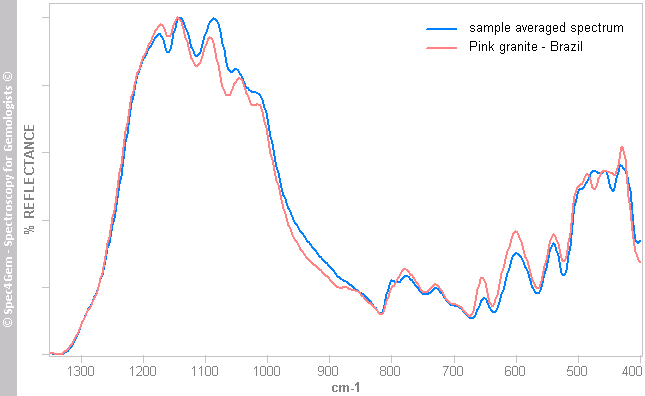 Figure 8. The cab's averaged IR reflectance spectrum is compared to that of a pink granite from Brazil, it is almost a perfect match confirming the cab is composed of granite rock.
 The IR reflectance spectroscopy was helpful to determine the cab's material which is a granite rock for both the blue orbs and the remaining parts of the cab. Nothing has been found yet regarding the blue orbs, no extra signal to identify the material (if there is one) causing the blue color knowing that granite is unknown in blue color up to now. The blue crystals are not so many in the rock and especially at the surface of the material where reflectance is acquired. IR microscope would be required to get spectra from such crystals, or a raman microscope, ...
UV-VIS-NIR spectroscopy:
The IR reflectance spectroscopy did not provide any evidence of additional material that could be the cause of the color (technical capacity). What does the blue of the orbs look like? Two UV-Vis-NIR spectra were acquired, one from the blue orb sample slice (not so thin section) and the other one from the gray slice, the spectra are plotted in figure 9. The gray sample spectrum shows a continuous absorption towards UV with a (or several) weak but large absorption band around 660 nm, the continuum gives the grayish white color. Regarding the blue orb sample, the spectrum seems to have the same absorption continuum as background with superimposed strong absorptions, one in the UV, one in the orange red, around 640 nm and one around 850 nm, the first two inducing the transmission window in the blue centered at 470 nm. It's important to note that the spectrum acquired from the blue orb sample is not the spectrum of the tiny blue crystals but the averaged spectrum of the blue orb, that is a least 10 mm2. Therefore the spectrum gives some information only about the global blue color. Assuming the 'diffused' blue material is the same as the cristalized one forming the tiny crystals is attractive but not necessarily right.
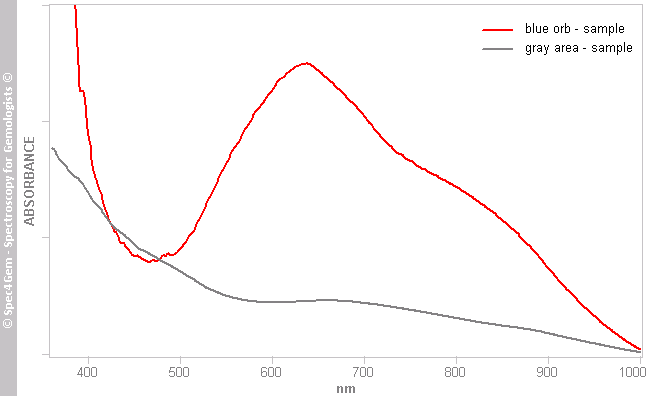 Figure 9. UV-Vis-NIR spectra acquired from the blue orb sample slice and from the gray sample slice. The gray sample spectrum shows a continuous absorption towards UV with a weak but large absorption band around 660 nm, the continuum gives the grayish white color. Regarding the blue orb sample, the spectrum seems to have the same absorption continuum as background with superimposed strong absorptions, one in the UV, one in the orange red, around 640 nm and one around 850 nm, the first two causing the transmission window in the blue centered at 470 nm.
 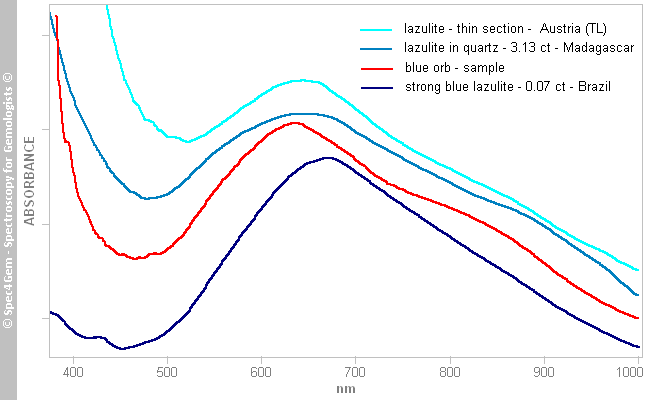 Figure 10. Lazulite UV-Vis-NIR spectra compared to that of the blue orb sample, similarities are evident.
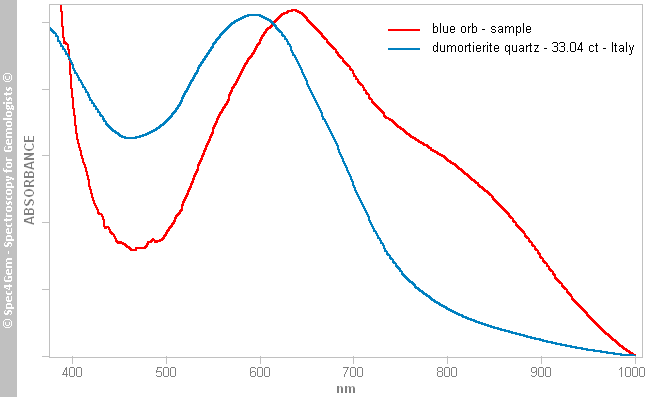 Figure 11. Dumortierite UV-Vis-NIR spectrum compared to that of the blue orb sample, some likeness but 850 nm band is missing.
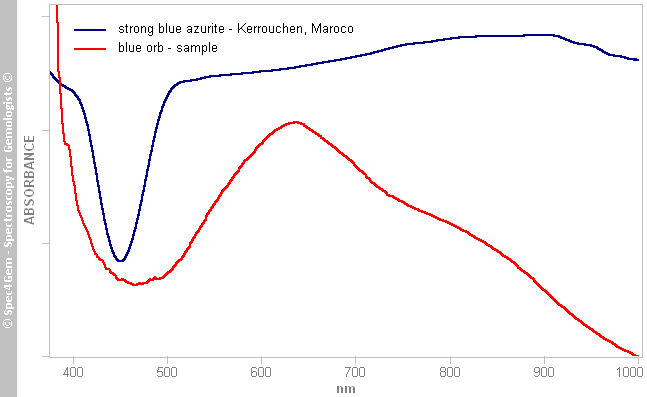 Figure 12. Azurite UV-Vis-NIR spectra compared to that of the blue orb sample, not comparable at all.
| Known as quartz inclusion | Available UV-Vis-NIR Spectra | Color Cause |
Comments |
Similar Spectrum 300 - 1000 nm |
|
| Ajoite | x | Cu | ? | ||
| Aerinite | x | Fe2+ - Fe3+ IVCT | ? | ||
| Azurite | x | Cu | The spectrum of azurite is quite characteristic with a strong continuous absorption over the UV-Vis-NIR spectral range with a transmission window around 440 nm, see figure 12, not comparable to the sample. | no | |
| Chrysocolla | x | Cu | UV-Vis-NIR reflectance spectrum of chrysocolla is available from USGS server[2], absorbance spectrum can be derived from it and it is similar to azurite one for the 350 - 1000 nm spectral range with a wide transmission window in the blue-green. | no | |
| Crocidolite / Riebeckite | x | Fe2+ - Fe3+ IVCT | Fibrous amphiboles which are not consistent with the observed crystals. | n.a. | |
| Dumortierite | x | x | Fe2+ - Ti4+ and Fe2+- Fe3+ IVCT |
The spectrum of dumortierite inclusions in quartz differs from that of the sample with only one main strong band at 600 nm, the 850 nm band is missing, see figure 11. | no |
| Indicolite | x | x | Fe2+ | The spectrum consists in a strong but wide band centered around 700 nm, not comparable to the sample. | no |
| Kinoite | x | Cu | ? | ||
| Lazulite / Scolarzite | x | x | Fe2+- Fe3+ IVCT | The spectrum of the sample is very similar to that of lazulite, either as a primary material or as an inclusion in quartz, see figure 10 showing several lazulite spectra for comparison to the sample. | yes |
| Papagoite | x | Cu | ? | ||
| Shattuckite | x | x | Cu | Characteristic Cu spectrum with global absorption except a narrow transmission window around 480 nm. | no |
| Trolleite | x | mixture with scolarzite | The trolleite is mostly colorless, sometimes green but not blue. Whenever it is blue, trolleite is mixed with scolarzite that is blue. Lazulite / Scorzalite spectrum would be likely observed. | n.a. | |
| Kyanite | occurs with quartz | x | Fe2+ - Ti4+ and Fe2+- Fe3+ IVCT |
Kyanite spectrum shows some likeness to that of the sample except that kyanite has a quite strong 'doublet' around 430 nm (Fe3+) which does not exist in the sample's spectrum. | no |
| Apatite (strong blue) | ? | x | MnO43- subsituting the PO43- site | Strong blue apatite (from Brazil) spectrum shows a similar pattern to that of the sample's spectrum with two strong and wide bands at 640 and 850 nm and a transmission window near 470 nm. | yes |
| Lazurite / Hauyne / Sodalite | never occur together with quartz | x | S3- | All feldspathoids never occur with quartz. Feldspathoids may occur along with feldspars in igneous rocks but they do not occur in igneous rocks containing original free silica—i.e., in rocks that contain quartz of the same generation (they are, in fact, incompatible with consanguineous quartz that derived from the same parent magma).
Lazurite and hauyne have a strong band near 600 nm but they lack the 850 nm band of the sample's spectrum. |
n.a. |
Table 2. Blue minerals, their occurence with quartz, their UV-Vis-NIR spectra and color cause and their comparison to the blue orb sample spectrum.
The UV-Vis-NIR spectra comparison is not complete because of the lack of some minerals spectra, however the performed comparisons lead to the emerging trend that the blue orb sample spectrum is very close to the spectrum of lazulite whereas it does not match at all the spectrum of azurite. Trying to compare spectra of minerals hosted by another minerals is possibly a wrong approach. A fact is that the spectrum of some minerals like lazulite, hematite, piemontite have the same UV-Vis-NIR spectrum signature if they are hosted as inclusions in a near-colorless to colorless mineral as if they are observed alone.
Photoluminescence spectroscopy:
No photoluminescence observed with the following excitation sources: 254, 280, 365, 405, 532, 650 and 680 nm.
Discussion:
The IR reflectance spectroscopy of this unsusal material lead to the conclusion the material is granite, that is confirmed by the visual observation (microscope) of the rock material (fine grained granite). The UV-Vis-NIR spectroscopy cannot substitute to chemical analysis but may indicate the color cause and in some cases the concerned material. The blue orb sample has a spectrum very similar to that of lazulite, a mineral which can found crystalized or as an inclusion in quartz (i.e. the quartz with lazulite from Madagascar). The azurite having a totally different spectrum is then excluded. Some dark blue apatites from Brazil, colored by MnO43- have also a similar spectrum but it is uncertained if it could exist as an inclusion in or together with quartz or feldspar, so it is also excluded at moment.
The UV-Vis-NIR spectrum is acquired globally from the blue orb but not from the tiny blue crystals, so the overall blue color spectrum looks like lazulite but it does mean the blue crystals are lazulite!!!
Another point not investigated yet, is the presence a small green crystal in the rock but only in the white areas, they never aoccur in the blue orbs. If we had blue azurite (that is excluded from UV-Vis-NIR spectrum), we would likely have green malachite crystals! There is also some other candidates which are not related to azurite, chlorite and possibly green feldspars...
At the time of the spectroscpic studies (novemver 2013), the results of the this study were: the material is a granite rock with blue orbs possibly colored by lazulite but the identity of blue crystals cannot be definitly determined.
Internet resources and post study facts:
- Spring 2012, GIA published in the Gems News International section of its Gems & Gemology journal, a short note about this material: Azurite in granitic rock from Pakistan. The conclusion is "Raman analysis by Garry Du Toit at GIA in Bangkok confirmed that the blue spots consist of azurite, which occur in a matrix of sodic plagioclase, quartz, and muscovite."
- October 2013, some information appeared on the internet stating the material is a granite from K2 with azurite blue orbs (geology.com[3]). A Mindat forum thread[4] started at the same period and it has last for quite a long time with so many posts. Sceptic people didn't believe it could be azurite since such association is not so common.
- December 18th 2013, Mindat forum: John Attard was able to isolate a grain of blue material and run EDX. The EDX spectrum[5] confirms this material to be azurite.
- May 23rd 2014, Mindat forum: James Ko-Chun Huang, Lab of Micro-Nano Mineral Science, Department of Earth Sciences, National Cheng Kung University, Tainan, Taiwan posted the results of his SEM analysis[6]:
- Azurite occur as micron sized veins in and around quartz or K-feldspar grains (Size range around 2-5μm in width) or as small pockets (5-20μm) in plagioclase which I suspect them as dissolution voids formed during hydrothermal alteration.
- The blue mineral are found as copper carbonate (azurite) as indicated by EDS data.
- Plagioclase which hosts void filling copper carbonates has composition close towards albite, which supports Dr. Barwood's observation.
- Very minor amount of Sulfur was detected in these secondary copper mineral, makes me wonder the possibility of pre-existing copper sulfides in the rock, which got alterated by late stage CO2 rich fluid event.
Overall, I think it explains why these blue spots seem overprinting the original rock textures of the granitoid, because they formed later than the rock matrix minerals. This can be evident by occurrence as veins and void filling.
Conclusion:
The material is a granite rock with blue orbs (like splashed blue raindrop). The blue zone includes many minutes blue crystals surrounded by 'dissolved' blue in the host material. Raman, EDX and SEM studies all identified the blue material as azurite, a copper carbonate.
However, a question is still pending, how to explain why the UV-Vis-NIR spectrum of the blue orb is a lazulite-like spectrum whose color cause is mainly iron but not the copper spectrum of azurite?
[1] Quartz a inclusions - Gemmo.eu
[2] Chrysocolla - USGS Digital splib04 Spectral Library
[3] Geology.com - 'K2 Granite,' also known as 'K2 Jasper'
[4] Home > General > General > K2
[5] EDX analysis - Courtesy of John Attard via Mindat
[6] SEM images ans spectra - Courtesy of James Ko-Chun Huang via Mindat