
Graves Hill is a very popular fossicking area located in Central Queensland, Australia. It is situated about 4 km west of Sapphire township and 10 km south of Rubyvale.
It is famous for its shallow wash hosting sapphires, generally these are 300–400 mm deep and expose a wash composed of angular to rounded pebbles and cobbles of billy, silicified sandstone and quartz set in a friable brown soil. Green and yellow sapphires have been found there as well as blues.
The parcel of small stones shown in figure 1 was kindly provided by Gem-Forest. The stones are rounded pebbles or broken ones with sometime sharp edges, they are all about 3 to 4 mm in size. There is one golden-brown crystal with a tabular habit showing trigonal forms ended by two basal pinacoids seen in the top-right corner of the figure 1.
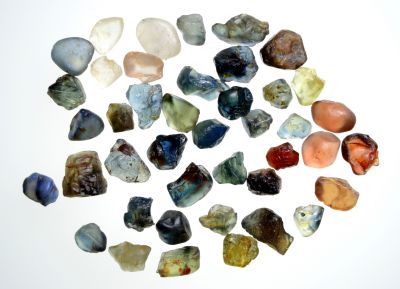 Figure 1. Small multicolored pebbles from the wash collected at
the Graves Hill gemfields.
Eleven stones were sampled from the parcel on color and clarity basis. They were numbered in figure 2 from 1 to 11 and they will further be referred to with the number and the associated color.
Sapphires are generally blue but often green and yellow or even orangy and brown and much more rarely colorless. Red could be ruby or garnet as found in the northern part of the area in Rubyvale, anyhow it is quite easy to separate a garnet from a ruby. On the other hand, zircons can be orangy, brown or colorless, sometime green or yellow, the occurence of the later two colors is unknown in Australia or not yet known. If the blues are sapphires for sure, answer is less obvious for the stones of the other colors which are present in this sampling. A quick run of UV-Vis and photoluminescence spectroscopy will help to definitely answer.
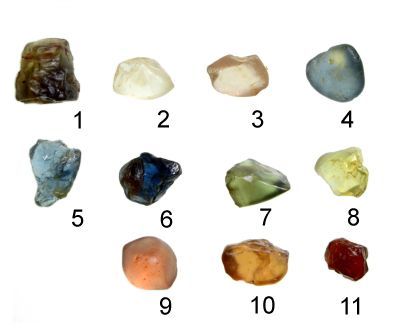 Figure 2. The eleven sampled stones with their assigned number.
UV-VIS-NIR spectroscopy:
The UV-Vis-NIR spectra (figure 3, 4) were collected without any particular orientation of the stones. The spectra were offset for better clarity. Once collected, the spectra were grouped according to their pattern. Two groups were isolated and named I and II, the group I (figure 3) showing spectra with an absorption band around 450 nm and the group II (figure 4) with the remaining spectra showing a increasing absorption towards UV. The group I (figure 3) is formed by the brown (#1), the light-yellow (#8), the green (#7) and the blue (#4, 5, 6) stones. The group II (figure 4) is formed by the colorless (#2), the orangish (#3, #9, #10) and the red (#11) stones.
The group I (figure 3) contains only sapphires with their characteristic spectra: 378, 388, 450, 470 nm and a larger band around 550 nm. Above 600 nm, spectra differ and may vary with light polarization. Brown, light-yellow and green stones show a spectra which is consistent with the iron(Fe3+)-bearing corundum, thus they are sapphires. The blues show the same Fe3+ features with the additional Fe2+<->Ti4+ IVCT (550-600 nm) and Fe2+<->Fe3+ IVCT (~900 nm), thus they are sapphires. The green sapphire (#7) shows also a weak Fe2+<->Ti4+ IVCT (550-600 nm) absorption band (the green is a blue and a yellow).
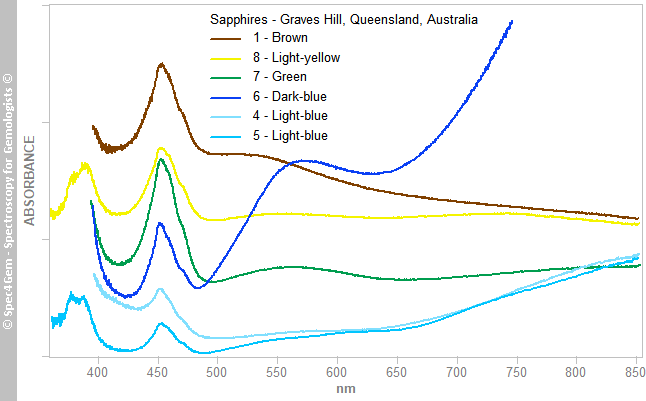 Figure 3. UV-VIS-NIR spectra of the brown (#1), the light-yellow (#8), the green (#7) and the blue (#4, #5, #6) stones forming the group I. The spectra are characteristic of sapphires: 378, 388, 450, 470 nm (Fe3+) and a larger band around 550 nm (Fe2+<->Ti4+ IVCT) and for the blues a strong and large band around 900 nm (Fe2+<->Fe3+ IVCT).
The group II (figure 4) contains the remaining stones which are colorless, orangish and red. The spectra of the red (#11), the pinkish-orange (#9) and the brownish-orange (#10) globally look the same excpet the red (#11) slightly differs with its band around 570 nm (note the corresponding spectrum was divided by 2 to be displayed on the same scale used for other stones) .
The spectra (#9, #10) are consistent with that of orange/brown zircon and can be compared to that of the Mud Tank (Harts Range) zircons.
The red (#11) stone is a garnet with strong absorption of the yellow, green and blue, very likely an iron-rich almandine-pyrope garnet.
The colorless stone (#2) shows a spectrum with several weak but distinct features at 590, 618, 654, 662 nm and a slight increase in absorption towards the UV, such spectrum is common for colorless zircon with uranium. The slightly-orangish stone (#3) spectrum does not have the uranium features but if scaled, the pattern is similar to that of the orangish ones with the increase of absorption from 600 nm to the UV.
 Figure 4. UV-Vis-NIR spectra of the red (#11), orangish (#9, 10, 3) and colorless (#2) stones forming the group II. The red stone [#11) shows a garnet spectrum and the orangish (#9, #10, #3) and colorless (#2) stones show zircon spectra. The colorless stone (#2) contains some uranium as shown by its particular spectrum 653 and 662 nm.
Photoluminescence spectroscopy:
All photoluminescence spectra with the excitation source at 405 nm (figure 5, 6) were recorded with the same integration time to give a relative indication of the luminescence intensity. The spectra were slightly offset for clarity. Again, it was easy to classify the spectra according to their pattern. Unlike for UV-Vis spectra, for which two groups can be distinguished, here there is three kind of spectra that can be identified, the spectra with an emission at 694 nm in the red but invisible to the eye, the spectra with emissions in the blue to yellow range causing a white color observed to the eye, and finally the spectra that do not show any luminescence for this excitation wavelength or that is two weak to be detected by the spectrophtometer. The later case concerns four stones which are the brown (#1), the pinkish-orange (#9), the brownish-orange (#10) and the red (#11).
The lack of luminescence for the red stone (#11) is consistent with its identification as a garnet, therefore its spectrum is not shown here since it is more like an exception here.
Grouping the spectra by pattern gives two groups, the group I (figure 5) formed by the stones #4, #5, #6, #7, #8 and the group II (figure 6) formed by the stones #2, #3. It is important to note that the groups are the same as for the the UV-Vis-NIR spectroscopy except for the four stones without any luminescence.
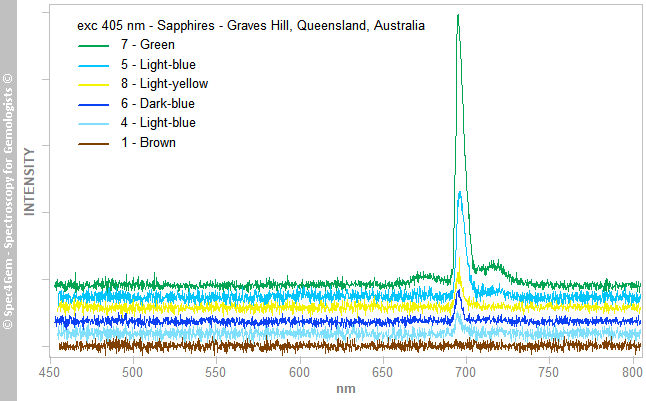 Figure 5. Photoluminescence spectra of the stones #4, #5, #6, #7, #8 and #1 for the excitation source at 405 nm. All stones except the #1, show the Cr3+ emissions in corundum identified by the 694 nm band and its associated sidebands.
Group I (figure 5), stones #4, #5, #6, #7, #8, shows an emission at 694 nm with sidebands which is characteristic of Cr3+ emissions in corundum. This is consistent with the identification provided by the UV-Vis-NIR spectroscopy.
Group II (figure 6), stones #2, #3, shows zircon luminescence (radiation defect centers and possibly REE), the strongest luminescence is produced by the colorless stone (#2). Again, this is consistent with the identification provided by the UV-Vis-NIR spectroscopy.
The stones without any significant spectrum were dispatched within the group as per their identification by UV-Vis-NIR spectroscopy, thus the stone #1 is put in the group I and the stones #9, #10 is put in the group II.
Zircon is well known for its yellow luminescence to the SWUV, this point encouraged to acquire spectra with such excitation source (254 nm), that was done for the stones #2, #3, #9 and #10.
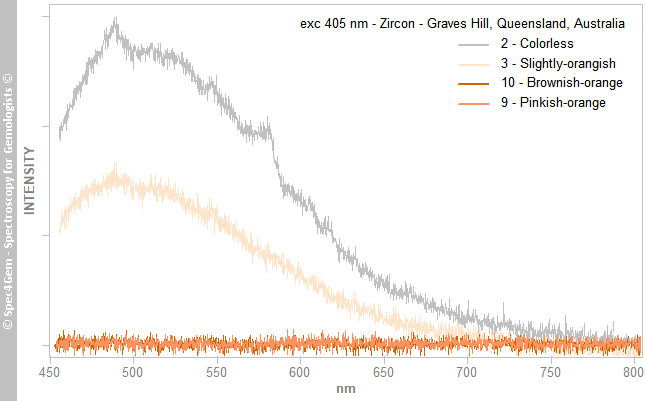 Figure 6. Photoluminescence spectra of the stones #2, #3, and #9, #10 for the excitation source at 405 nm. The stones #2, #3 show the emissions of radiation defect centers and possibly REE in zircon, the stones #9, #10 do not show any emission under the current condition of acquisition (integration time, excitation source power).
 The 254 nm excitation source caused four stones (#2, #3, #9, #10) to emit yellow light that is visible to the eye, others were inert with no emission spectrum. The spectra of these four stones are shown in figure 7. The strongest emission is as for the 405 nm excitation the one of the colorless stone. The slightly orangish one (#3) is much weaker but still easily seen. The orangish stones (#9, #10) show a weak emission unlike for the 405 nm excitation and it is in all points similar to that of other zircons.
As it has already been brought up, the 'lack' of emission with the 405 nm source for the stones #9, #10 does not mean there was no emission at all, but likely the integration time to collect their spectra was too low in respect to their emission level.
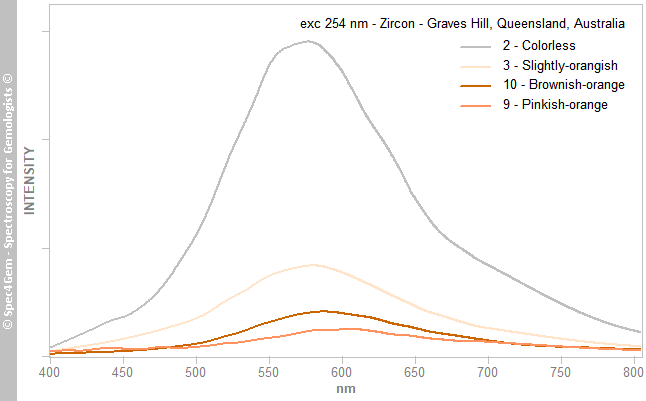 Figure 7. Photoluminescence spectra of the stones #2, #3, #9, #10 for the excitation source at 254 nm. All stones show the emission of radiation defect centers around 570 nm.
Conclusion:
Graves Hill gemfields are mostly known for their sapphires found in the wash but other species like zircons and garnets can be found there as shown by this basic spectroscopic study.
The sapphires are blue, green, yellow or even brown, all colored by iron and the blues and greens by iron and titanium. They all contain chromium as traces as proven by the luminescence spectroscopy except for the brown for which the spectroscopy settings did not enable to reveal its presence.
The zircons are generally orangish, with different hue of orange (pinkish-orange, brownish-orange, ...) or even colorless. The colorless shows some traces of uranium although the orangish exhibits radiation defect centers.
A single garnet stone was present and is an iron-rich garnet from the pyrope-almandine series.