

Zircon from Mud Tank zircon field, Northern Territories, Australia
- Details
- Created: Sunday, 25 September 2016 10:58
The Northern Territories state of Australia has been known for its zircon with the so particular 'peach' color, something between light pink and light yellow, sometime a bit purplish. There are several places where zircon can be found in the south of the state, especially at the well known ancient Mud Tank zircon field near the Gemtree caravan park about 170 km northeast of Alice Spring. There are other fossicking spots in the Harts Ranges mountains that go along the south of the Plenty Highway between Gemtree and Atitjere community (Harts Range).
The rough gemstones of the figure 1 were kindly provided by Murray Fairhead who went for fossicking in the Mud Tank Zircon field.
These gemstone range in color from nearly colorless to melting of very light pink, yellow and orange. Three stones were selected for this report, the dark orange one (id: Z1), the very light pink one (id: Z2) and the nearly colorless with very light yellow hue one (id: Z3).
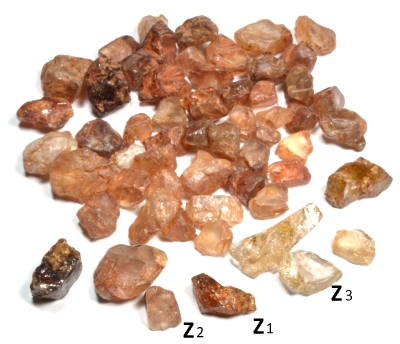 Figure 1. Zircons from the Mud Tank zircon field with the three
marked samples selected for this report.
| Sample | Z1 | Z2 | Z3 |
| Shape | rough with sharp edges | rounded terminated crystal part | rough |
| Size | 13 x 7.5 x 5 mm | 8 x 6 x 6 mm | 12 x 9 x 3.5 mm |
| Color | dark orange | very light pink (purplish-pink) | nearly colorless to very light yellow |
| Lustre | very bright vitreous | ||
| Weight | 4.96 ct | 3.86 ct | 4.99 ct |
| SG | 4.61 | 4.70 | 4.66 |
| RI | not measured because raw surface of material, anyway OTL | ||
| DR | not measured because raw surface of material, anyway OTL | ||
| Pleochroism | none observed | ||
| Polariscope / Conoscope | light/dark 4 times / 360° -> anistropic, optical axis not found, uniaxial property could not be verified | ||
| SWUV | strong yellow-orange | inert | moderate yellow-orange |
| LWUV | moderate orange | weak yellow-orange | weak yellow-orange |
| Magnetic susceptibility | diamagnetic | ||
| Radioactivity | below the ambient natural level (<0.1μSv.h-1) | ||
Table 1. Observational and measured properties. The SG values indicate the samples are 'high' zircons, the non-metamict ones, for which SG is comprised between 4.50 and 4.75. The 'low' zircons, the metamict ones, structurally damaged by the radiations, have their SG comprised between 3.87 and 4.10.
The SG values put these Mud Tank zircons in the category of the 'high' zircon, in other words the crystal structure of these zircons have not been yet dislocated by the radiations. The main source of radiations is the Uranium incorporated in the crystal and/or sometime in less extent the Thorium. In the present case, either the U contents is rather low and there is not enough radiation to destroy the crystal structure or the gemstones are rather young and then there has been not enough time yet for the radiation to disorder the crystal. Mud Tank zircons are usually dated about 730 Ma (730.106 years)[1][2], that is rather old compared to Sri-lankan zircon (350 - 450 Ma).
Infrared reflectance spectroscopy:
The IR reflectance spectrum of the Z1 sample (4.96 ct, dark-orange zircon) shown in figure 2 was acquired from a face of the rough (not a crystal face). It gives a clear spectrum characteristic of zircon, the same spectrum was obtained from other samples. The brown well formed crystal seen at the bottom left corner of the figure 1, provided oriented spectrum from its crystal's faces, they are not published in this report.
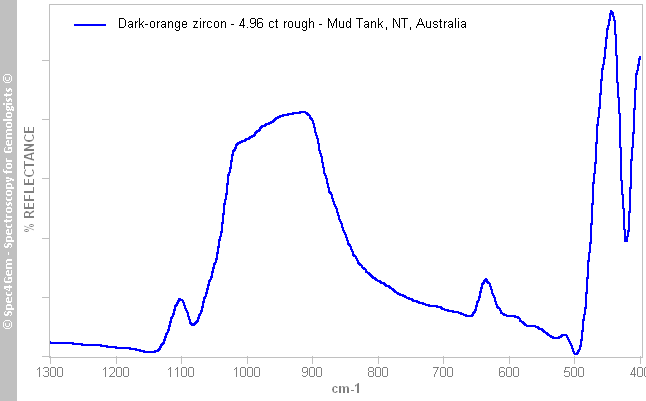 Figure 2. The Z1's IR reflectance spectrum shows a characteristic zircon spectrum. All samples produce the same characteristic spectrum.
UV-VIS-NIR spectroscopy:
Zircons are optically uniaxial, they usually offer two kind of UV-Vis spectra, one for each light polarization direction (E||C and E_|_C) that can be worded another way, one for the ordinary ray and one for the extraordinary ray. In such zircons, the difference is not significant (no pleochroism was observed), so there wa no try to acquire polarized spectra. Unless the light path is oriented in a particular crystal direction, the spectrum is a combination of both spectra. The UV-Vis spectra of the three samples are displayed in figure 3 on the default 400-775 nm range.
All three spectra are very similar except the absorption level that is higher in Z1 than in Z2 than in Z3. There is an absorption continuum starting around 775 nm that grows towards the higher energies (UV, 400 nm and further). Such absorption pattern is usually responsible for the brown-orange color and it is attributed to radiation defect induced centers.
The absorption continuum is associated with weak absorption features at 654, 663 and 691 nm which are attributed to the incorporated U4+ ions in the crystal structure replacing the Zr4+ ions. Up to forty lines like these ones might be present in a zircon spectrum. The 654 nm is also observed in the colorless zircon even with a hand-held spectroscope and is generally diagnostic for zircon material!
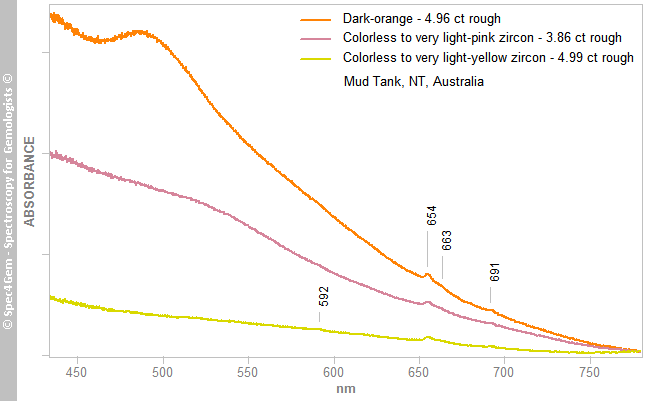 Figure 3. The UV-Vis spectra of the three samples, Z1, Z2 and Z3, all showing the same kind of spectrum in which only the absorption level differs and explains the color of the samples. The usual 654, 663 and 691 nm U4+ bands are present. The Z3 sample shows a 592 nm band that is also just visible in the Z2 spectrum, likely U4+ related.
The Z2 sample, the very light pink/purple one, has a distinct broad absorption band at 530-540 nm, such a band is also observed in the pink zircon found in the Umba valley in Tanzania. There is no particular explanation yet.
The Z3 sample, the nearly colorless one, shows a band at 592 nm (also just visible in Z2) and at 892 and 914 nm (not shown in the spectrum of figure 3), very weak but they are really there. All are also attributed to U4+ even if the 592 nm could be ascribed to REE, especially to Nd3+ like for Malawi zircons. However Nd3+ is very unlikely in these Mud Tank zircons, there is no luminescence related to Nd3+ in the Z3's PL spectrum of figure 6. Anyway it is rather complicated to get a precise attribution since the U4+ and REE often coexist. The photoluminescence spectroscopy may help.
Photoluminescence spectroscopy:
The photoluminescence spectra were acquired with a 405 nm excitation laser source for each sample. Despite the power of the source, the luminescence was rather weak with Z3 sample showing the weakest. Luminescence spectra with a 254 nm and a 280 nm sources were acquired but as they do not bring more information than the 405 nm ones, they are not published in this report.
The Z1's photoluminescence spectrum excited at 405 nm (figure 4), shows a typical emission attributed to the radiation induced centers[3], here peaking at 620 nm. The 656 and 691 nm are re-absorption bands, the same as the absorption bands in the UV-Vis spectra of the figure 3 except in this particular case they absorb the emitted light instead of the transmitted one. Two possible weak emission at 605 and 617 nm might be ascribed to REE, possibly Sm3+[1].
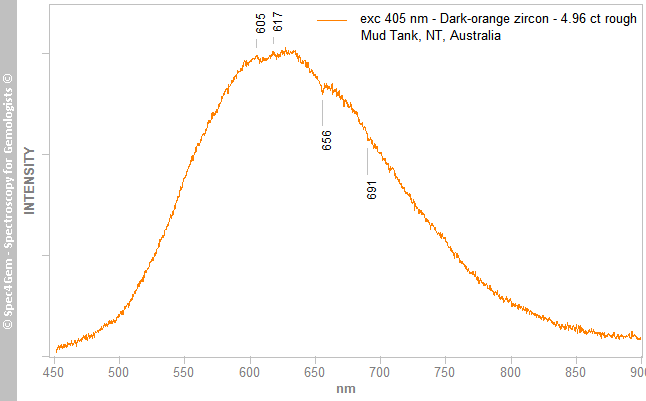 Figure 4. The Z1's photoluminescence spectrum excited at 405 nm, shows a typical emission attributed to the U4+ radiation induced centers, here peaking at 620 nm. The 656 and 691 nm are re-absorption bands. Two possible weak emission at 605 and 617 nm might be ascribed to REE, possibly Sm3+.
The Z2's photoluminescence spectrum excited at 405 nm (figure 5), shows a typical emission attributed to the radiation induced centers, here peaking at 590. The 655 nm is a re-absorption band, as described for Z1 sample PL luminescence. Another re-absorption band may exist at 592 nm but because of the vicinity of the 581 nm emission feature it is not obvious. The 488 and 578, 581 nm emission features could be ascribed to the Dy3+ REE[3].
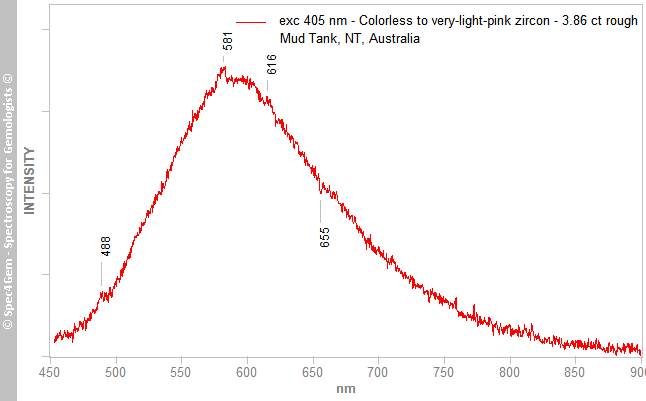 Figure 5. The Z2's photoluminescence spectrum excited at 405 nm, shows a typical emission attributed to the radiation induced centers, here peaking at 590 nm. The 655 nm is a re-absorption band. The 488 and 581 nm emission features could be ascribed to the Dy3+ REE.
The Z3's photoluminescence spectrum excited at 405 nm (figure 6), shows the combination of multiple emission centers, the first one is the typical emission attributed to the radiation induced centers, here peaking at 590 nm and the other ones are related to REE photoluminescence. The overall luminescence is really weak but unlike for the Z1 and Z2 samples, the REE emissions are well defined. According to Gaft et al.[3], assignments can be as follows:
- 474, 483, 488, 578, 581: Dy3+,
- 605, 617, 652: Sm3+,
- 664: ?,
- 725: Sm3+.
The 693 nm is a re-absorption band. Another one may exist at 592 nm but because of the two adjacent emission peaks, it cannot be confirmed.
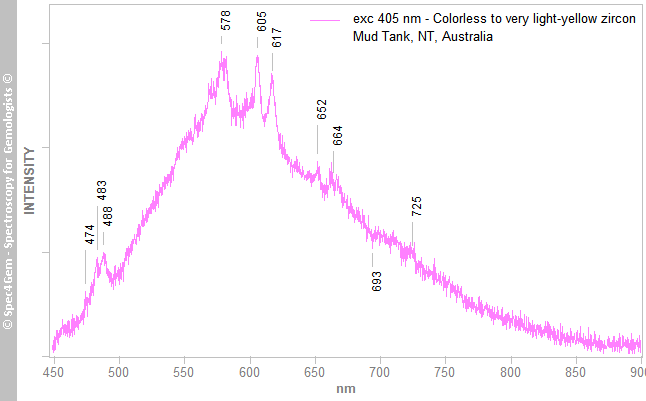 Figure 6. The Z3's photoluminescence spectrum excited at 405 nm, shows a typical emission attributed to the radiation induced centers, here peaking at 590 nm. The luminescence is really weak but unlike for the Z1 and Z2 samples, the REE emissions are well defined. According to Gaft et al. assignments can be [474, 483, 488, 578, 581]: Dy3+; [605, 617, 652]: Sm3+; [664]: ?; [725]: Sm3+. The 693 nm is a re-absorption band.
From the photoluminescence spectra , it can be assumed that all three samples contain U4+ (re-absorption lines, radiation induced centers) as well as REE (emission lines) such as Dy3+ and Sm3+.
Heating experiment:
A very light purplish pink rough was selected for the experiment. It was cleaned on the 600 grid lap to get a preformed weighting 0.87 ct where it was possible to have the light path for the UV-Vis spectroscopy to get the E_|_C ray. A spectrum was acquired before heating the stone and another one after the heating process (figure 7), with the same light path to able to compare absorption levels. Heating process was reduced to the most simple one, no particular oven, just the cooking gas burner to do the job. The stone was put in the flame with the tweezers for about 15 seconds, that's it! The stone turned immediately colorless. The colorless change seems to be stable after a week, still colorless.
The heating experiment was conducted on only one sample therefore the unique result cannot be generalized to all pinkish zircons of that locality unless the experiment is repeated with more samples.
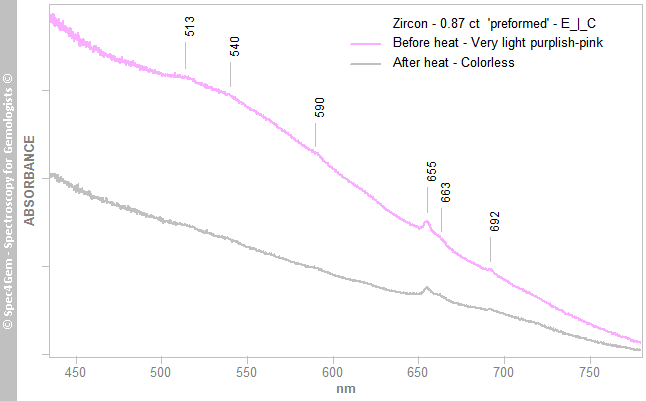 Figure 7. The UV-Vis absorption spectra of the 0.87 ct sample before (pink spectrum) and after (gray spectrum) heating process. Both spectra show the 'line' bands at 513, 540, 590, 655, 663 and 692 nm, likely related to U4+, the heat did not modify them The pink zircon broad band at 540 nm is no longer observed after heat. The absorption continuum towards UV is much lower after heating, the balanced spectrum explains the lack of color.
The UV-Vis spectra of the figure 7 shows the change in absorption operated by the brief heating process. The absorbance decreased on the full spectrum range. This change, by reducing the absorption on the violet to yellow range of the spectrum, the red being already weakly absorbed, balanced the spectrum resulting in a nearly colorless zircon.
The spectra are decorated with a set of 'line' bands at 513, 540, 590, 655, 663 and 692 nm, likely related to U4+. The heat did not modify them.
As for Z2 sample, this 0.87 ct sample, also light purplish-pink, shows the weak and broad band around 540 nm which is about 100 nm width. This feature is no longer observed after heating, this is sufficiently remarkable to be highlighted.
The photoluminescence spectrum is not modified by the heating process.
Conclusion:
The Mud Tank zircons owe their color to the radiation defect induced centers those the existence is confirmed by the UV-Vis and PL spectroscopy. The radiation induced centers are connected to U4+ which replaces the Zr4+ in the crystal structure. The U4+ UV-Vis features are quite weak and they are not as prominent as for the zircons with high U4+ content, that suggests a low U contents for these gemstones. A low U content is also consistent with the age of these gemstones since the crystal is not disordered through the ages.
Regarding the REE, they believably do not play a role in the color of these zircons. Sm3+ and Dy3+ are present in the gemstone as pointed by the PL luminescence spectroscopy but likely in very low quantities.
A property that should be remembered about these pinkish zircons is that they are very sensitive to heat since they loose their color while exposed to the flame of a gas burner or a cigarette lighter!
[1] The age of the Mud Tank Carbonatite, Strangways Range, Northern Territory, L. P Black and B. L. Gulson, BMR Journal of Australian Geology & Geophysics, 3, 1978, pp. 227-232
[2] Simultaneous determinations of U–Pb age, Hf isotopes and trace element compositions of zircon by excimer laser-ablation quadrupole and multiple-collector ICP-MS, Chemical Geology, 247, 2008, pp. 100-118
[3] Modern Luminescence Spectroscopy of Minerals and Materials, 2nd Edition, M. Gaft, R. Reisfeld, G. Panczer, Springer Editor, ISBN: 9783319247632