
The bluish-green material as shown in figure 1 was sold as chrysoprase from Haneti, Kondoa district in Tanzania. Chrysoprase and prase opal are quite similar in appearance but gemological properties are distinct.
Tanzania is known for providing gem quality chrysoprase and prase opal since the the middle of the seventies. The historical source is between Haneti and Itiso, north to Dodoma[1][2][3][5]. Exploited since 2014, a much more recent deposit, near Kwa Mtoro village in the Kondoa district[4], provides prase opal. Both places are located on the map as indicated in figure 2.
Infrared reflectance spectroscopy will help to easily distinguish both material because chrysoprase is a chalcedony variety that has a higher crystallinity than opal that tends to be almost amorphous but not as much as obsidian.
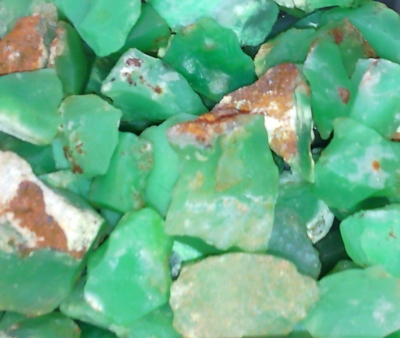 Figure 1. Chrysoprase or prase opal rough from Kondoa, Tanzania.
| Shape | rough |
| Size |
19.8 x 11.0 x 10.3 mm |
| Color | bluish-green - nearly opaque to almost semi-transparent |
| Lustre | greasy on unpolished surfaces but almost vitreous on polished window |
| Weight | 12.52 ct (12.20 ct after polishing a window for reading RI) |
| SG | 2.55 (the rough is clean, no visible extra material as it can be seen on some pieces of figure 1, no fracture, ...) |
| RI | 1.545 |
| DR | - |
| Pleochroism | - |
| Polariscope / Conoscope | stays light through 360° -> possibly polycristalline |
| SWUV | inert |
| LWUV | inert |
| Magnetic susceptibility | very weak with N52 magnet |
Table 1. Observational and measured properties
The only one piece of rough observed in this report is a chrysoprase according to the classical gemological properties summarized in table 1. It would be most accurate to qualify it of chalcedony since the color cause is not yet established, chrysoprase being the green variety of chalcedony colored by nickel.
There is a major difference between the appearances of the material whether the later is polished or not. The polished material takes an almost vitreous luster, but the unpolished one with its natural surface takes a greasy to dull luster. The edges are also not as sharp as that can be observed on opal broken rough. The 'conchoidal' fractures seen in opals are not observed.
The rough extracted from the above-mentioned localities are extracted from veins, resulting in broken rough with rather sharp edges and a quite good luster. The sample's surfaces are rather uneven, grainy but nevertheless slightly reflective.
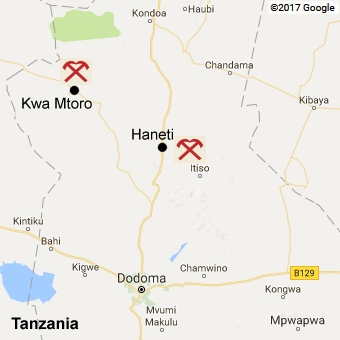 Figure 2. Map of Dodoma region where both Haneti
and Kondoa deposits are located.
Infrared reflectance spectroscopy:
The infrared reflectance spectrum (figure 3) was acquired from a natural area of the rough without being polished unlike it was done for reading the optical refractive index.
The spectrum shows four main features at 478, 780, 1110 and 1270 cm-1. Such a spectrum is characteristic of an intermediate material between fully crystalline / ordered quartz and mostly amorphous obsidian. The crystallinity and also the ordered arrangement of the SiO4-tetrahedron decrease from quartz to obsidian (glass) as follows:
quartz → chalcedony → opal-CT → opal-A → obsidian (glass).
Chrysoprase is a variety of chalcedony that contains small quantities of nickel and its infrared reflectance spectrum is fully similar to that of chalcedony. The spectrum of chalcedony is similar to that of quartz (690, 780, 800, 1110, 1176 cm-1) except the 780 and 800 cm-1 bands are not as sharp as for quartz but they are distinctly present in the spectra. As the cristallinity and the SiO4-tetrahedron ordered arrangement decrease, the double bands at 780 and 800 cm-1, merge to a single band at 780 cm-1 in the case of opals and the 690 cm-1 disappears. This is exactly what can be observed in figure 3 spectrum. From that, it is already easy and possible to conclude the material is rather an opal silica than a chalcedony. The prominent bands at 1110 and 1270 cm-1 do confirm that. Moreover the 478 cm-1 band tends to indicate the opal is rather an opal-CT type than an opal-A type that should have such band at a position close to 470 cm-1 and its 1110 cm-1 band shifted to 1116 cm-1.
The spectrum is unambiguous and despite that, the gemological properties indicate a chalcedony, both results are inconsistent. What is wrong here?
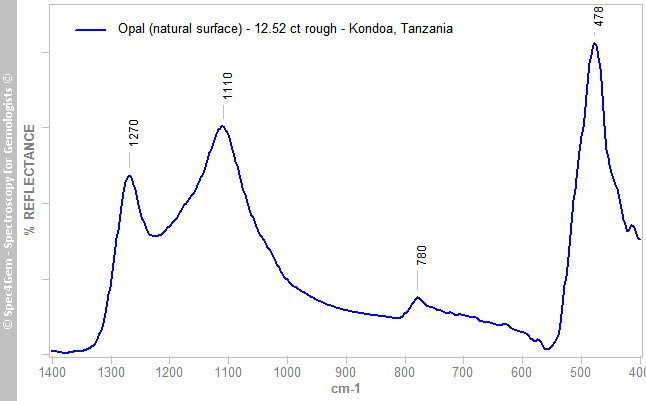 Figure 3. IR reflectance spectrum of the natural surface of the bluish-green 12.52 ct rough material from Kondoa, Tanzania. The 478, 780 and 1110 cm-1 bands and the missing one at 690 cm-1 characterize opal, the 478 cm-1 band indicates an opal-CT.
Some more spectra acquisitions were processed on similar area of the stone, all gave the same spectrum pattern matching opal-CT material. Finally, another spectrum was taken from the polished surface established for reading the RI, the spectrum is available figure 4. It is amazingly quite different than that obtained from the natural surface.
The 483, 692, 780, 800, 1109 and 1182 cm-1 reflectance bands indicate a material with a higher crystallinity, a better ordered structure, typically as this is generally observed for the chalcedony. So, would it make sense to conclude the overall material is chalcedony (possibly chrysoprase because of its color) which is naturally coated – the term may be inappropriate as it often refers to a kind of gemstone treatment – with a layer of opal being either the interface with its hosting rock or the result of any external alteration?
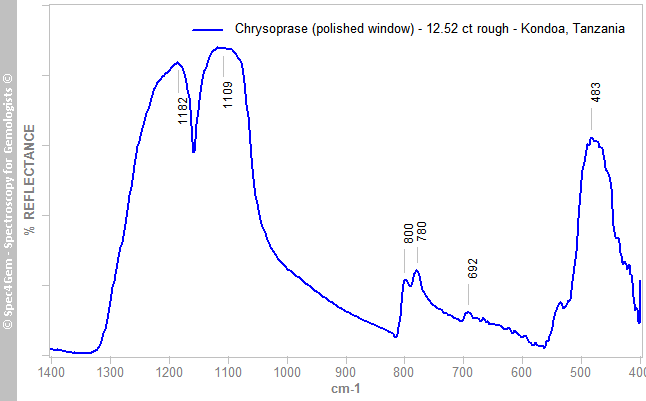 Figure 4. IR reflectance spectrum of the polished window of the bluish-green 12.52 ct rough material from Kondoa, Tanzania. The 483, 692, 780, 800, 1109 and 1182 cm-1 bands indicate a material with a higher crystallinity, a better ordered structure, typically as for chalcedony.
Anyway, the core material identified as chalcedony by spectroscopy is now consistent with the classical gemological properties of the sample. The opal layer/coating is likely negligible, the sample's S.G. does not seem to be lowered by this opal extra material usually having a S.G. around 2.10.
UV-VIS-NIR spectroscopy:
The UV-Vis-NIR absorption spectrum was acquired by light transmission in a part of the rough relatively thin compared to the rest of the stone. It would be interesting to get another rough to slice it to a thin layer to be able to get the spectrum in UV and blue without being faced to spectrometer and light source limits. Nevertheless, the obtained spectrum (figure 5) is well defined and it is unambiguously related to Ni exactly as it is with chrysoprase. Two main absorption bands at 652 and 741 remove the yellow, the orange and the red. Another absorption expected around 400 nm, starting at 500 nm removes the blue and violet from the transmitted light. The formed transmission around 540 nm window is thus responsible for the bluish-green color of the material.
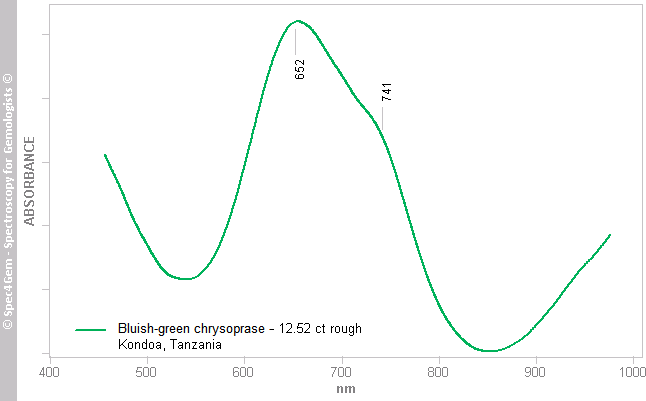 Figure 5. UV-Vis-NIR absorption spectrum, two main absorption bands at 652 and 741m associated with the expected 400 nm band form a transmission window in the green responsible for the bluish-green color of this rough material.
The absorption band position have been precisely computed from the spectra as it can be seen in figure 6, fitting is almost perfect. It is important to understand this is just a possible model which may be different from the real one. However, the value are consistent with published values.
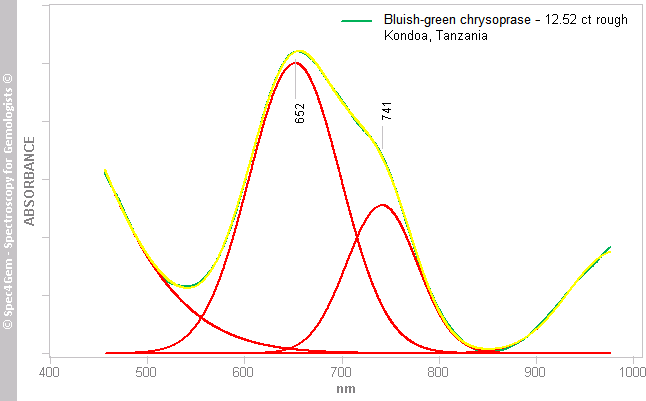 Figure 6. UV-Vis-NIR absorption spectrum, the almost perfect absorption band fitting gives the 652 and 741 nm bands.
Photoluminescence spectroscopy:
No luminescence was observed with the conventional SWUV and LWUV sources. The 405 nm laser seems to activate a whitish blue luminescence but it is not yet clear if this is a true luminescence or another phenomenon such as light scattering or some artifact. This has yet to be investigated... Such luminescence is known to exist in green opals but for the given material it has to be clearly established.
After Zwaan [4], his analyzed samples show a luminescence that varies from inert to a weak chalky-blue while excited by LWUV whereas they show a weak yellowish-green luminescence while exposed to SWUV, those observation applied to opal but not to chrysoprase.
Discussion:
The conventional gemological tests, RI=1.545, S.G.=2.55, polycrystalline under polaricope, lead to conclude the material is chalcedony. This is confirmed by the IR reflectance spectroscopy even if opal is detected on the outer of the sample. The UV-Vis-NIR spectroscopy shows the chalcedony material is colored in bluish-green by nickel, thus the material is chrysoprase.
Published in 2009 by E. Shigley et al[3] the data about the chrysoprase and prase opal historically mined close to Haneti north to Dodoma give for chrysoprase – RI=1.549±0.002, SG=2.57-2.63 – and for prase opal – RI=1.455±0.004, SG=2.09-2.13 – the rough sample's values are very slightly lower than those of Haneti chrysoprase but the difference is not significant.
After Zwaan[4] who published in The Journal of Gemmology his analysis about similar material coming from the Kondoa district but from a new mining area near the Kwa Mtoro village located north west of Haneti, for which the SG is as low as 2.17 which is consistent with opal but without any RI published. Raman spectrum also pointed out the opal-CT material and the chemical analysis indicated the presence of Ni. Zwaan did not mention the presence of chrysoprase in this new deposit but this does not mean it does not exist there, just he has not got a sample of such chrysoprase if it does exist.
The piece of rough material analyzed here is chrysoprase, the nickelean chalcedony. Unless data are published about occurrence of chrysoprase in Kwa Mtoro, it is reliable to assume this chrysoprase material comes from Haneti as indicated by the dealer. Anyway, there is no hint to disprove that information.
[1] Green opal from East Africa, J. I. Koivula, C. W. Fryer, Gems & Gemmology, 1984, Winter, pp. 226-227
[2] Gem-quality Chrysoprase from Haneti-Itiso area, Central Tanzania, K. A. Kinnunen, E. J. Malisa, Bull. Geol. Soc. Finland 62, Part 2, pp. 157–166
[3] Chrysoprase and Prase Opal from Haneti, Central Tanzania, J. E. Shigley, B. M. Laurs, and N. D. Renfro, Gems & Gemmology, 2009, Winter, pp. 271–279
[4] Green Prase Opal from the Kondoa District, Tanzania, J. C. (Hanco) Zwaan, Journal of Gemmology, 2015, volume 34, No.8, pp. 658–660
[5] Gemological, physical and chemical properties of prase opals from Hanety Hill (Tanzania), F. Caucia, L. Marinoni, C. Ghisoli, A. Leone, Periodico di Mineralogia, 2016, 85, pp. 41–50