
This 3.43 ct yellow apatite was submitted as a yellow tanzanian danburite. The color / hue is well saturated and even if the gemstone had a quite deep pavilion, the cut performs well in returning the light. Luster is rather good. Really looks like a danburite...
The stone has only one inclusion, that can be observed on the picure 1, but as the later is a planar inclusion oriented perpendicularly to the table, it does not really affect the visual aspect of the gemstone.
The measured properties (table 1) differ from that of danburite except for DR but they fall in apatite properties ranges. Spectroscopy is performed to confirm the classic gemology testing and to collect additional information about the color origin.
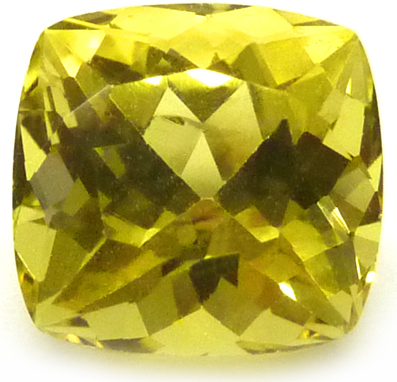 Figure 1. The 3.43 ct yellow apatite sparkling like a danburite.
| Shape | square cushion |
| Size | 8.4 x 8.2 x 6.8 mm |
| Color | strong yellow |
| Lustre | vitreous |
| Weight | 3.43 ct |
| SG | 3.15 |
| RI | 1.644 - 1.650 |
| DR | 0.006 U- |
| Pleochroism | strong yellow / light yellow |
| Polariscope / Conoscope | light/dark 4 times / 360°, extinctions seem to show some strain - Uniaxial figure |
| SWUV | inert |
| LWUV | inert |
| Magnetic susceptibility | unchecked |
Table 1. Observational and measured properties
Infrared reflectance spectroscopy:
The IR reflectance spectrum (figure 2) was acquired from the gemstone's table. It unambiguously shows a characteristic pattern of a phosphate family mineral and it perfectly matches apatite IR reflectance spectra. This spectrum is compared to that of a colorless danburite from Mexico which is a silicate having a totally different spectral pattern as presented in figure 3.
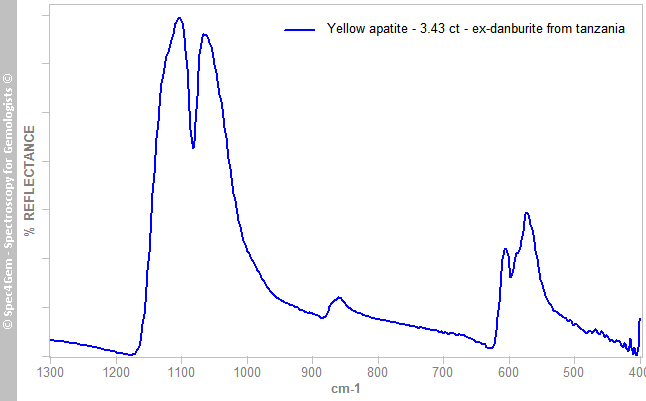 Figure 2. IR reflectance spectrum of the 3.41 ct yellow gemstone that is characteristic of phosphates minerals and especially in this particular case characteristic of apatite.
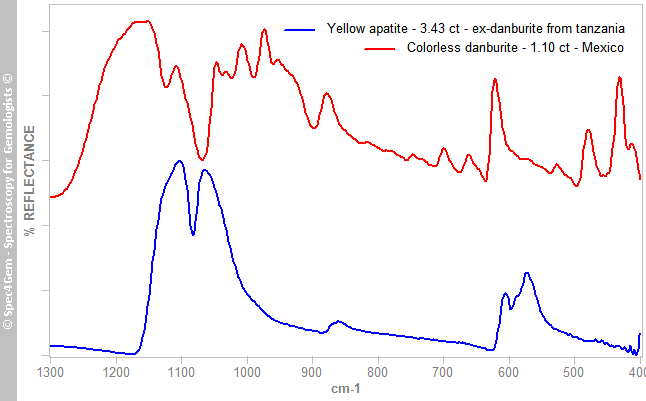 Figure 3. IR reflectance spectrum of the 3.41 ct yellow gemstone (blue spectrum) compared to a colorless danburite one (red spectrum). It is again obvious that the 3.41 ct yellow gemstone is not a danburite.
The UV-Vis-PIR absorbance spectrum (figure 4) was acquired with a light path oriented from the culet and towards and perpendicularly to the gemstone's table. The spectrum is composed of an absorption continuum growing towards the UV region on which weaker absorption bands are added, especially the doublets at 576 and 589 nm, 739 and 749 nm, and the weakest bands at 808 nm and 871 nm band. Such a spectrum is usually attributed to REE and natural radiation induced color centers in apatite materials.
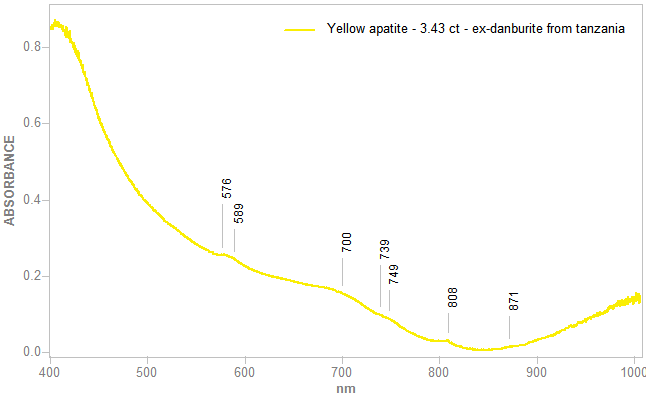 Figure 4. UV-Vis-PIR spectrum of the 3.41 ct yellow gemstone. The spectrum is composed of an absorption continuum growing towards the UV region on which weaker absorption bands are added, especially the doublets at 576 and 589 nm, 739 and 749 nm, and a larger band almost centered on 700 nm followed by the weakest bands at 808 nm and 871 nm bands. Such a spectrum is usually attributed to REE and natural radiation induced color centers in apatite materials.
 Photoluminescence spectroscopy:
The photoluminescence spectrum was acquired with a 405 nm laser with a power of 20 mW. The photoluminescence emission is orange.
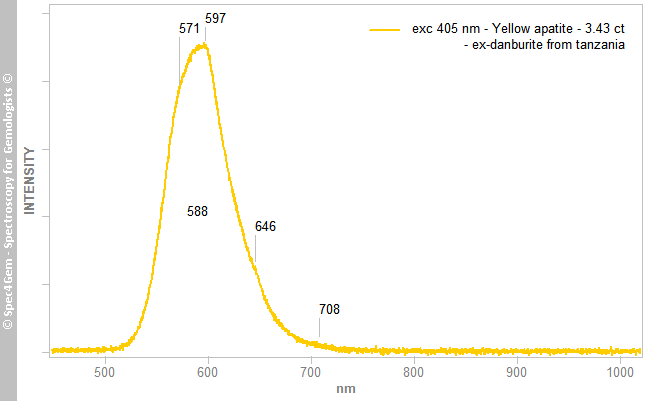 Figure 5. Photoluminescence spectrum of the 3.41 ct yellow gemstone excited with a 405 nm source. The photo-emission is easily observed and it is orange.
The photoluminescence spectrum (figure 5) over the 450-1000 nm range shows a main wide peak around 588 nm to which are added three peaks at 571, 597 and 646 nm. Such a spectrum is characteristic of the REE spectra in fluoraptite [1], especially with Sm3+ ions at 567, 600, 646 and 708 nm. The 588 nm peak is well-known in apatite [1] and it is attributed to Mn2+ ions replacing Ca2+.
Conclusion:
Classic gemology tests are unambiguous except the DR with a value of 0.006 that is consistent with danburite, all other properties do not match the values for the danburite. However, all are consistent with apatite. IR reflectance, UV-Vis-PIR and photoluminescence spectroscopies, all confirm that the material is apatite and therefore that danburite is definitely excluded.