
Smithsonite is a zinc carbonate with formula ZnCO3 that is quite soft with a hardness of only 4-4.5. It is found in various part of the world, from Namibia to Mexico and China, and it is one of the most important ore for the extraction of Zinc. It can be found in various colors.
The gemstone shown in figure 1 is a new material coming from China that shows a pink-red photoluminescence under SWUV excitation.
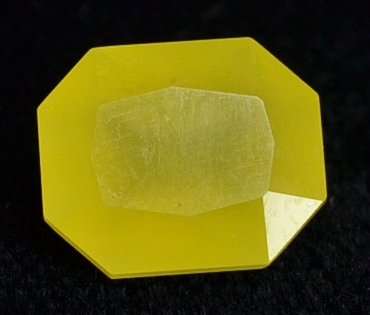 Figure 1. 3.89 ct yellow smithsonite from China
| Shape | octogonal cushion cut |
| Size | 7.8 x 9.4 x 5.2 mm |
| Color | yellow |
| Lustre | greasy |
| Weight | 3.89 ct |
| SG | 4.37 |
| RI | 1.619 - OTL |
| DR | immeasurable because of second OTL RI |
| Pleochroism | none |
| Polariscope / Conoscope | stays light through 360° |
| SWUV | pink-red (weak with a 4W SWUV lamp) |
| LWUV | inert |
| Magnetic susceptibility | inert |
Table 1. Observational and measured properties
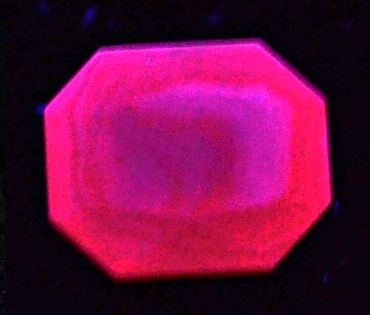 Figure 2. 3.89 ct yellow smithsonite under SWUV
This smithsonite shows an unusual photoluminescence under SWUV excitation (figure 2). The photoluminesce is rather weak with a standard 4W SWUV lamp.
Infrared reflectance spectroscopy:
The IR reflectance spectrum as represented figure 3 was acquired from the table of the gemstone. The 742 cm-1 sharp band (CO32- ν4 in plane bend) being diagnostic of the smithsonite material in the calcite group.
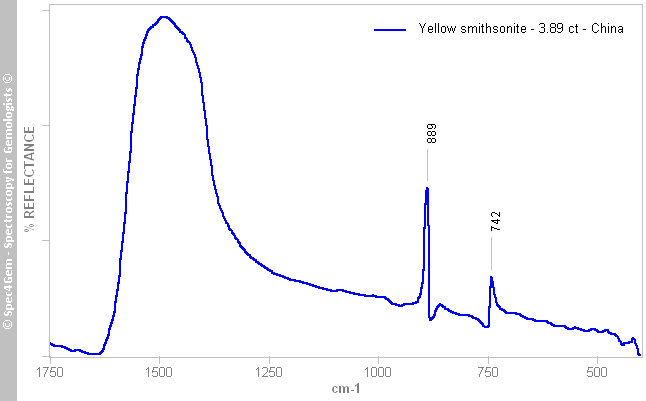 Figure 3. IR reflectance spectrum of the 3.89 ct yellow smithsonite showing the 742 cm-1 sharp band (CO32- ν4 in plane bend) being diagnostic of the smithsonite material.
UV-VIS-NIR spectroscopy:
The UV-Vis-PIR absorption spectra (figure 4) was acquired with a light path aligned to the direction defined by the culet to the table. It shows an absorption continuum growing towards UV with a main absorption band (shoulder) near 460 nm and additional overlapping absorption bands at 547, 580, 612, 741 and 800 nm.
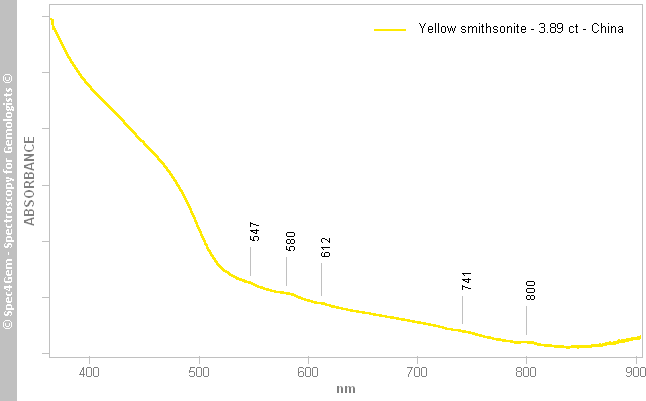 Figure 4. UV-Vis-PIR spectrum of the 3.89 ct yellow smithsonite showing an absorption continuum growing towards UV with a main absorption band (shoulder) near 460 nm and with additional overlapping absorption bands at 547, 580, 612, 741 and 800 nm.
According to the publication "An Effective Tool and Method for Gem Identification - The Magnetic Metals that Color Gems"[1] by Kirk Feral, the yellow smithsonite is colored by the cadmium (Cd) transition metal. Lesser amount of manganese (Mn) can be present as well. Cd and Mn can explain the strong absorption in the violet but the do not explain the additional bands at 547, 580, 612, 741 and 800 nm. It can be interesting to compare the UV-Vis-PIR absorption spectrum of this smithsonite to that of the yellow apatite with REE bands. Even if the bands are less intense in the smithsonite, they are very similar to that of the apatite. Could these bands caused by REE ?
Photoluminescence spectroscopy:
The photoluminescence spectra (figure 5) were acquired with two excitation sources, 254 (red spectrum) and 405 nm (green spectrum). The 405 nm produces a green luminescence although the 254 nm produces a red luminescence, both are observable without any instrument. Both excitations produces the same emission peaks but with different level. While excited by 405 nm, the 523 nm peak is the strongest peak and the 665 nm one is the weakest, whereas the 523 nm peak is the weakest peak and the 665 nm one is the strongest with the 254 nm excitation. Note that intensities are not comparable to intensities of the other spectrum, they have been adjusted for the picture rendering.
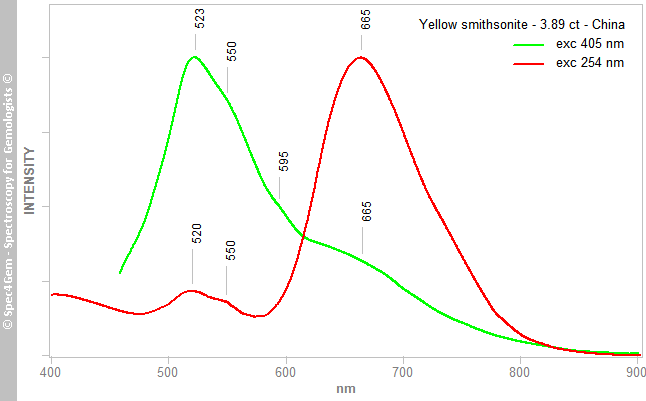 Figure 5. Photoluminescence spectrum of the 3.89 ct yellow smithsonite excited by a 405 nm source (green spectrum) and by a 254 nm source (red spectrum). The 405 nm produces a green luminescence although the 254 nm produces a red luminescence, both are observable without any instrument. Both excitations produces the same emission peaks but with different level. While excited by 405 nm, the 523 nm peak is the strongest peak and the 665 nm one is the weakest, whereas the 523 nm peak is the weakest peak and the 665 nm one is the strongest with the 254 nm excitation.
Detected photoluminescence emission peaks with their possible attribution for both 254 and 405 nm excitation are summarized in table 2. Except the 665 emission peak attributed to Mn2+, 680 nm by Gaft et al[2], all the other band do not have any explained attribution in the literature. The UV-Vis-PIR absorption spectrum lets expect the presence of REE in the material even if this is not confirmed, the emission peaks at 523 and 550 nm could possibly be attributed to REE.
| Emission peak (nm) |
Activator | References | |
| 254 nm exc | 405 nm exc | ||
| 523 | 520 | Initially attributed to Mn2+ by Gorobets and Rogojine[3], but non confirmed by Gaft et al[2]. | [2], [3] |
| 550 | 550 | Not described by Gorobets and Rogojine[3], nor by Gaft et al[2]. ? | [2], [3] |
| 595 | - | Appears but not described in L2 spectrum, Gorobets and Rogojine[3]. | [3] |
| 665 | 665 | Mn2+, given for 680 nm by Gaft et al[2]. | [2] |
Discussion:
This 3.89 ct yellow smithsonite owe its color to cadmium as described in the literature and its red luminescence to Mn2+ replacing Zn2+ ions in the carbonate crystalline structure. The green luminescence as the weak absorptions spread over the 547 - 800 nm region of the UV-Vis-PIR spectrum could possibly be assigned to REE.
[1] An Effective Tool and Method for Gem Identification - The Magnetic Metals that Color Gems p. 4. Kirk Feral (2009).
[2] Modern Luminescence Spectroscopy of Minerals and Materials, 2nd Edition, 2015, M. Gaft, R. Reisfeld, G. Panczer, ISBN: 9783319247632, p. 107 & p. 128.
[3] Luminescent Spectra of Minerals, Boris S. Gorobets and Alexandre A. Rogojine, Moscow, 2002, ISBN: 5901837053, p. 175.