
Sold as an hibonite crystal from Esiva, Maromby Commune, Amboasary District, Anosy Region, Madagascar, the crystal (figure 1) looks mostly like an hexagonal crystal to the novice, hibonite crystallizing in hexagonal system.
After some observations, the crystal is found to be a monoclinic crystal with a tabular habit (figure 2), thus it cannot be hibonite that is only known to belong to the hexagonal crystal system.
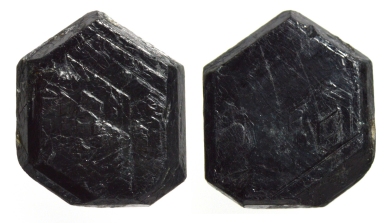 Figure 1. Main faces of the crystal with interesting growing marks.
| Shape | crystal |
| Size | 12.0 x 11.3 x 12.2 x 3.3 mm |
| Color | black - opaque |
| Lustre | bright vitreous |
| Weight | 5.14 |
| SG | 3.52 |
| RI | ~ 1.71 |
| DR | - |
| Pleochroism | none |
| Polariscope / Conoscope | na |
| SWUV | inert |
| LWUV | inert |
| Magnetic susceptibility | moderate, N52 magnet drags it |
The optical (IR) and physical (SG) properties were used to search the Gemmo.eu[1] database with the criteria IR=1.710 and SG=3.52, black color was omitted since it returned only 5 entries, the results are enumerated in the table 2. The black colored minerals are allanite, augite, garnet, hedenbergite and serendibite, although that it is not possible to get the crystal identified.
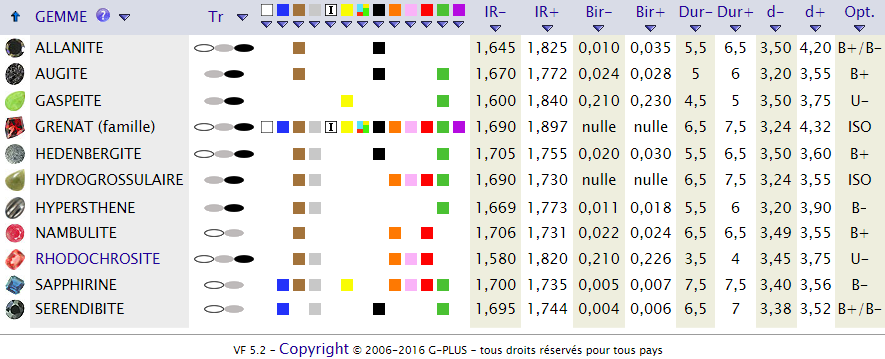 Table 2. Gemmo.eu[1] database search with the criteria IR=1.710 and SG=3.52, black color was omitted since it returned only 5 entries.
A similar search was operated in Mindat[2] database with the following criteria SG=3.52 color=black, the results were scored in 3 categories: 100% (SG and color), 55% (SG only) and 44% (color only). With 100%, titanite, aegirine, augite,allanite are listed with many more, serendibite is scored 55% and sapphirine is never listed while it is given with a SG=3.4 in that database, the topaz with the same SG is listed!
The Mindat search was refined by setting a SG range from 3.4 to 3.7 and black color, the sapphirine appears on the fourth page with the serendibite and a score of 55% (SG only). The search behaviour is not clearly understandable. Anyway, it is still impossible to identify the crystal.
The few classical gemology properties are not sufficient to get an identification, we will try to determine the crystal's system.
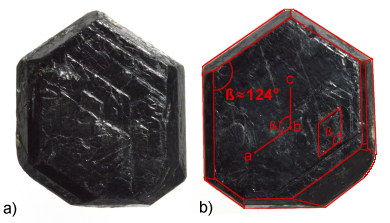
Figure 2. The crystal's edges are drown in red on one of the two main faces showing the β angle and the axis directions of the crystal cell unit.
The crystal's edges were drown (figure 2) to facilitate the observation of the crystal's symetries. There is only one twofold axis of rotation oriented in the b axis direction and one mirror plane parallel y oriented to the photography plane, thus the crystal belongs to the monoclinic system with a β angle of almost 124° (α and γ being equal to 90°).
The uneven growth marks on the (010) face show very distinguishing symmetry features with the β angle.
From those observations, the crystal cannot be an hexagonal crystal of hibonite. Monoclinic system contains more than 1600 minerals, a rapid search in the American Mineralogist Crystal Structure Database[3] with α=γ=90° and 122°≤β≤126° returns about 74 entries, whose the most common are harmotome, sapphirine, lowsonite, epistilbite, cristobalite, ...
Infrared reflectance spectroscopy:
Infrared reflectance spectrum was acquired from the (010) crystal face photographed on the b) picture of figure 2.
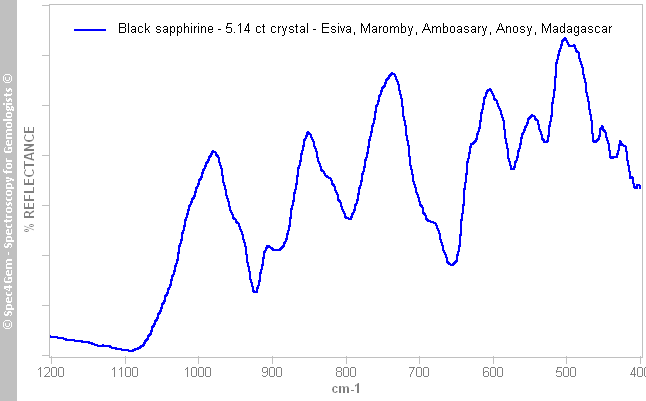 Figure 3. IR reflectance spectrum of the (010) face as photographed on b) picture of figure 2. The spectrum is quite complex with numerous reflectance bands from 400cm-1 to 1100 cm-1. This spectrum matches perfectly the sapphirine spectra of bluish sapphirines from Madagascar and Sri-Lanka.
The obtained infrared reflectance spectrum (figure 3) is quite complex with numerous reflectance bands from 400cm-1 to 1100 cm-1. The spectrum complexity is in general related to molecular complexity and layout of the mineral. This appears in complex minerals like tourmaline, beryl. A search into the internal IRS database results in a perfect match with sapphirine spectra from Madagascar and Sri-lanka location. Sapphirine is an inosilicates with 4-periodic single chains, Si4O12, and it is a member of the sapphirine group along Khmaralite.
UV-VIS-NIR spectroscopy:
Not applicable
Photoluminescence spectroscopy:
Not applicable
Discussion:
Classical gemology properties were not sufficient to identify this black crystal. Again, IR reflectance spectroscopy gave the answer as long as the searching database is plentifully populated with species spectra, the material of this black crystal is sapphirine. Sapphirine IR spectra are not common in the literature.
This unusual black sapphirine monoclinic crystal from Madagascar is consistent with sapphirine data, IR≈1.71 and SG=3.52. Known sapphirine is usually non-magnetic, but this crystal is dragged by a N52 magnet, indicating a rather strong magnetic susceptibility likely caused by some impurities.
[1] Gemmo.eu - Base de données de gemmologie pour mieux connaître et identifier les gemmes, synthèses & imitations