
Ammolite is a trade name given to a thin iridescent aragonite shell material that is found on two species of extinct ammonites fossils (Placenticeras meeki and Placenticeras intercalare). It is a rare material. All of the world's commercial production comes from a small area along the St. Mary River in southwestern Alberta, Canada.
Ammolite is known for its spectacular display of iridescent color when it is observed in reflected light. The colors of an individual stone can run the full range of the visible spectrum or be limited to just one or two colors.
he color-producing shell layer of Ammolite is usually very thin (often less than one millimetre) and attached to a dark gray to brown base of shale or siderite. Most Ammolite is used to produce triplets. These are made by backing the fragile iridescent material with a thin slab for stability and topping it with a transparent cover for protection. Many stones can be impregnated with epoxy for stability.
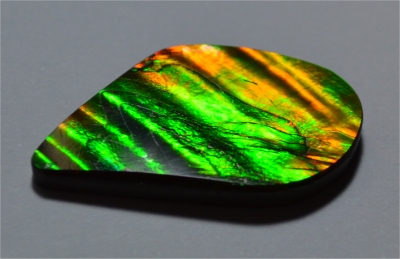 Figure 1. 10.66 ct Ammolite viewed at ~45° from normal.
 Through visual observation of the sample described here, there is no easy evidence of a doublet, triplet is excluded because a clear caps / top is easily detected with the unaided eye or with a 10x lens. First of all, there is the amazing flatness of the junction between ammolite material and its base. Not sure the shell of ammonites fossils are as flat as this ! Then the observation of this junction under microscope with a 405 nm laser source, reveals a straight line of pale blue color. This color also expands in some fractures and some bubles can be observed here and there. From that, it is possible to state that we have a doublet.
The base is made of a reddish-brown material which is not polished enough for reading RI nor acquiring a IR reflectance spectrum. The decision is taken to polish it to get the IR spectrum and to determine its material.
| Shape | free form cab |
| Size | 25.2 x 14.0 x 2.8 mm |
| Color | green to reddish-orange for the top, brown for the back |
| Lustre | nacreous |
| Weight | 10.66 ct (10.47 ct after polishing the base for IR spectroscopy) |
| SG | 3.13 |
| SWUV | inert |
| LWUV | inert |
| Magnetic susceptibility | picked up by N52 magnet |
Table 1. Observational and measured properties
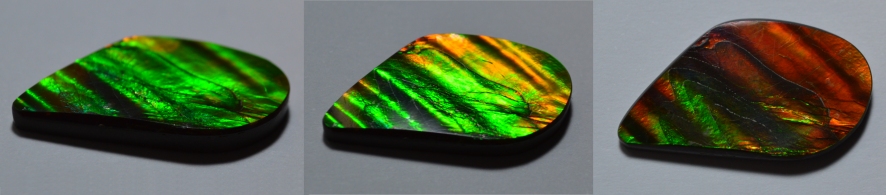 Figure 2. From left to right, the 10.66 ct Ammolite is viewed at ~70°, ~45°and 15°from normal (vertical), showing the interesting play of color.
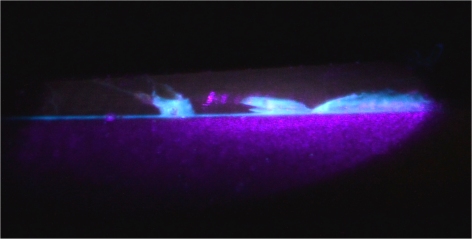 Figure 3. The cab's side exposed to 405 nm laser light shows a bluish luminescence located at the junction line between ammolite top and its siderire base, and expanding within the ammolite top fractures.
 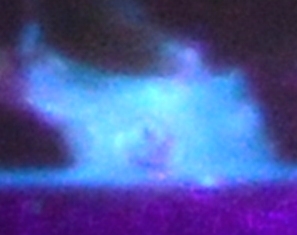 Figure 4. A bubble within the material filling a fracture in the ammolite top next to the junction.
Infrared reflectance spectroscopy:
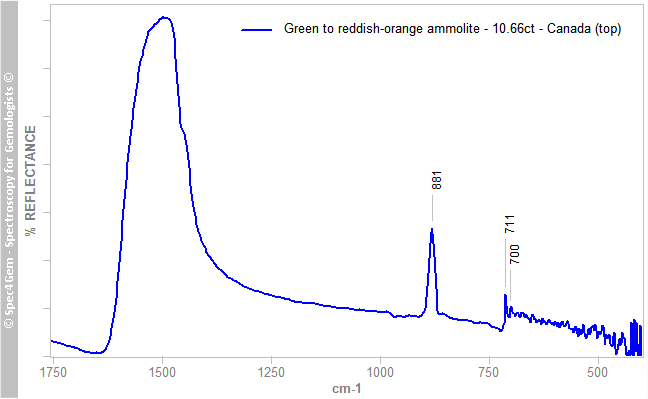
Figure 5. IR reflectance spectrum of the top of the ammolite cab, the 700 and 711 cm-1 bands are diagnostic of aragonite.
The analysis of the top of this 10.66 ct ammolite by IR reflectance confirms the "shell" material as aragonite (figure 5). This is consistent with the ammolite data.
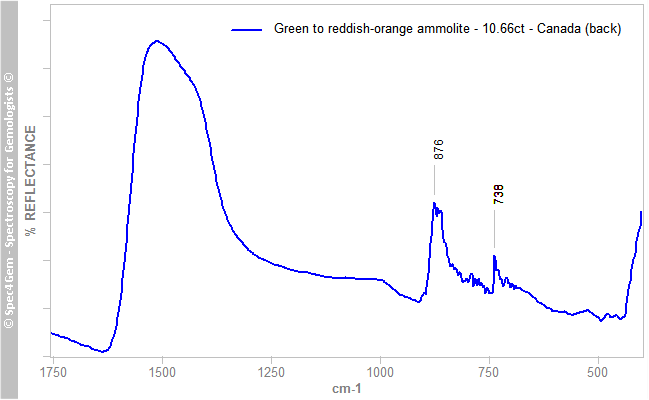
Figure 6. IR reflectance spectrum of the base of the ammolite cab, the 738 cm-1 band is diagnostic of siderite.
The analysis of the base of this 10.66 ct ammolite by IR reflectance (figure 6) leads to the conclusion that siderite, a iron(II) carbonate (FeCO3), is the material of the base. This is consistent with the ammolite data.
Conclusion:
Both classical gemology results and IR reflectance spectroscopy results confirm the free form cab with an interesting play of color is ammolite, an assembly of two materials, aragonite for the thin top layer and siderite for the base. This 'assembly' is not the result of mother nature as it could be expected for such specimen but the result of a human work to stabilize the ammolite material.