
Brazilianite is a quite rare phosphate mineral which is mainly known for its green-yellow color, but color often ranges from pale-yellow to greenish-yellow. Greenish-yellow brazilianite as a gemstone often comes from Brazil from which its name is derived, especially from the Conselheiro Pena and Mantena area in Minas Gerais state. Brazilianite is a fairly recent mineral since its discovery was circa 1944 in Minas Gerais. Besides the occurences previously quoted, some more do exist in the world as in USA, Rwanda, Canada, Argentina, China, France and Australia.
Colorless brazilianite, even if it is lesser known to gemstone lovers than to mineral collectors, the later have mainly collected it for decades from the New Hampshire mines in the USA.
Good to know: while heated, brazilianite begins to lose its color as low temperature as 200°C but turns colorless above only 300°C!
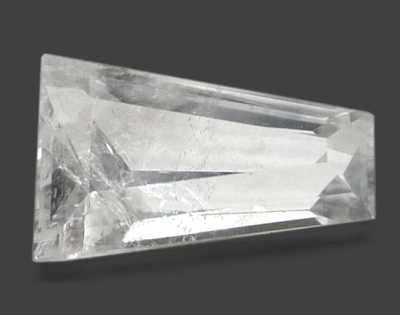 Figure 1. 1.17 ct colorless brazilianite from the Palermo Mine,
 Groton, Grafton County, New Hampshire, USA.
| Shape | fancy, truncated triangle |
| Size | 8.5 x 5.3 x 4.0 mm |
| Color | colorless |
| Lustre | vitreous |
| Weight | 1.17 ct |
| SG | 2.93 [2.96 - 3.00] |
| RI | 1.602-1.622 |
| DR | 0.020 B+ |
| Pleochroism | none (colorless) |
| Polariscope / Conoscope | anisotropic: light/dark 4 times / 360°, conoscope not used |
| SWUV | inert |
| LWUV | inert |
| Magnetic susceptibility N52 | inert |
| Chelsea filter | colorless |
Table 1. Observational and measured properties
Infrared reflectance spectroscopy:
The infrared reflectance spectrum of this 1.17 ct colorless brazilianite gemstone (figure 2) was collected from its table. The spectrum pattern is characteristic of brazilianite specie and matches other brazilianite spectra in the database.
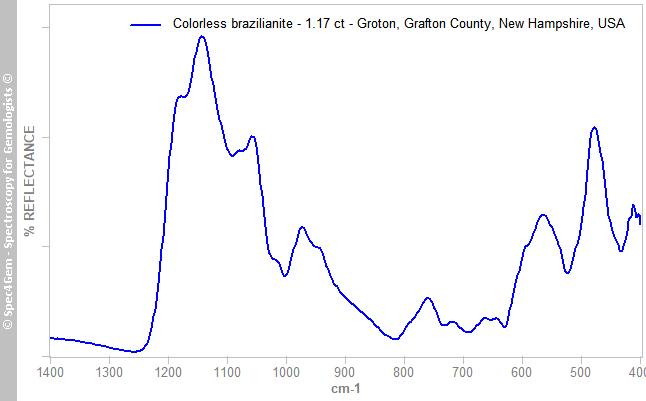 Figure 2. IR reflectance spectrum of the 1.17 colorless brazilianite. The spectrum pattern is characteristic of brazilianite specie and matches other brazilianite spectra in the database.
 UV-VIS-NIR spectroscopy:
The UV-Vis-NIR absorption spectrum of the 1.17 colorless brazilianite (figure 3) was collected with the light path perpendicular to the table. It shows an almost full transmission over the visible spectrum that makes the stone colorless. The NIR absorption above 800 nm is unexplained.
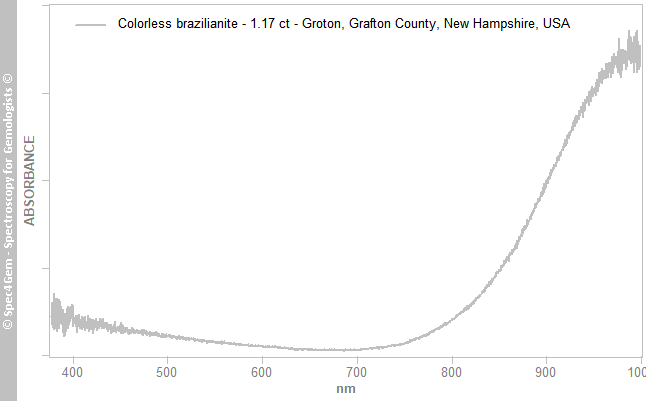 Figure 3. UV-Vis-NIR absorption spectrum of the 1.17 colorless brazilianite. The almost full transmission over the visible spectrum makes the stone colorless. The NIR absorption above 800 nm is unexplained.
Photoluminescence spectroscopy:
No photoluminescence with the following sources: 254, 280, 375, 405 and 532 nm.
Conclusion:
All mesured and observed gemological properties are consistent with that of brazilianite. The infrared reflectance spectrum is diagnostic of the specie. Colorless brazilianite are known but are quite rare in facetted gemstone of gem quality. In USA, the New Hampshire mines produce few specimens every now and then. It was important to report about such colorless brazilianite gemstone that will create for itself a place of choice among the collections of colorless gemstones.