
Yet another vesuvianite with an interesting color, nor green neither yellow, something in the middle with a milky / blurry appearance. The faceted gemstone from this report comes from Akhtaranda area in Yakutia, Russia where it is found as massive aggregates of thin crystal of inter-grown vesuvianite and hydrogrossular garnet. These two species often occur together and it often leads to confusion. It would have been interesting to analyze the rough material to study the mixed / inter-grown material.
The faceted gemstone is shown in figure 1.
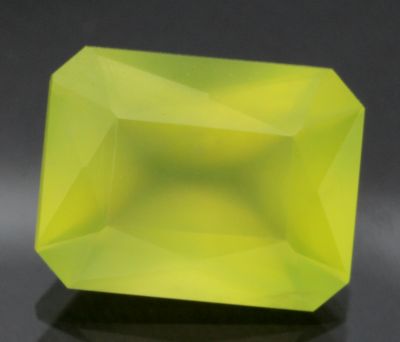 Figure 1. The pretty milky-greenish-yellow color of this 3.48 ct
 vesuvianite makes it a very attractive gemstone.
| Shape | rectangle scisor cut |
| Size | 10.0 x 7.8 x 5.6 mm |
| Color | milky-greenish-yellow |
| Lustre | vitreous to dull |
| Weight | 3.48 ct |
| SG | 3.35 |
| RI | ~ 1.705/8 |
| DR | - |
| Pleochroism | - |
| Polariscope / Conoscope | stays light over 360° while observed in any direction -> polycrystalline |
| SWUV | inert |
| LWUV | inert |
| Magnetic susceptibility N52 | weak |
| Chelsea filter | same color as without filter |
Table 1. Observational and measured properties
Infrared reflectance spectroscopy:
The IR reflectance spectroscopy was operated on few facets of the gemstone to collect multiple spectra to check if both vesuvianite and hydrogrossular garnet could be detected. All facets gave the same spectrum as shown in figure 2 which is characteristic of vesuvianite and not of hydrogrossular garnet. This does not tell there is no hydrogrossular garnet in the stone but simply all facets are cut on vesuvianite material.
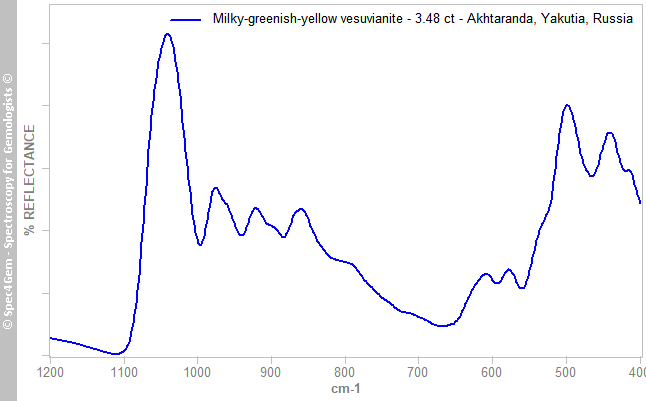 Figure 2. The IR reflectance spectra of few facets of this 3.48 ct gemstone, all show the vesuvianite characteristic spectrum. There was no trace of hydrogrossular garnet on the facets.
UV-VIS-NIR spectroscopy:
The UV-Vis-NIR spectrum (figure 3) was collected without any particular orientation, the light path was perpendicular to the table. The spectrum pattern is very characteristic of vesuvianite and it is usually explained by the presence of Fe3+ iron traces.
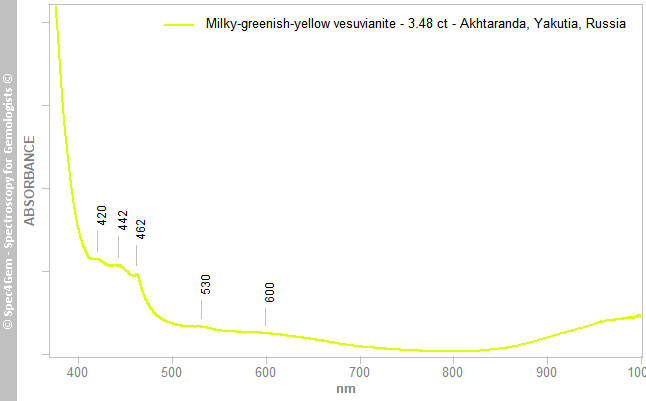 Figure 3. The UV-Vis-NIR spectrum of this 3.48 ct milky-greenish-yellow gemstone is common for Fe3+-bearing vesuvianite.
Photoluminescence spectroscopy:
No photoluminescence with excitation source at 405 nm.
Conclusion:
The blurry / milky appearance of this vesuvianite from Akhtaranda area in Yakutia, Russia gives the gemstone a unique and interesting visual aspect. The vesuvianite often inter-grows with hydrogrossular garnet and as the classical gemological properties are close, it is difficult to separate them from each other. The uniaxial optical character of vesuvianite and the isotropic optical characteristic of hydrogrossular garnet are useless if the material is polycrystalline while observed with the polaricope since these properties cannot be determined in that particular case. The IR spectroscopy gives a clear answer to the question as well as in a lesser extent the UV-Vis-NIR spectroscopy does, which is the vesuvianite is the main material of this pretty colored gemstone.