
Gaspeite is an extremely rare mineral with a pretty yellowish-apple-green color, only found in a handful of locations worldwide, including Canada and Western Australia.
Gaspeite belongs to the calcite group of minerals, a group of related carbonates that are isomorphous with one another. They are similar in many physical properties, and may partially or fully replace one another, forming a solid solution series.
Gaspeite has recently become popular among both mineral and gemstone collectors. It is available on internet but sometimes the gaspeite is just a gaspeite imitation often made of dyed magnesite a close mineral 'cousin' since gaspeite forms a solid solution serie with magnesite.
A cheap string of 'gaspeite' (sold as is) chips was bought on internet just for curiosity!
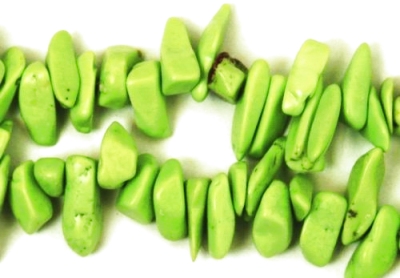 Figure 1. Strong yellowish-green 'gaspeite' chips drilled and
 beaded on a nylon string.
| Shape | tumbled chips stones |
| Size | 4 x 4 x 2 up to 10 x 5 x 4 mm |
| Color | yellowish-green (figure 1), few brown veins and white areas, many chips show small bluish-green spots. |
| Lustre | dull, waxy |
| SG | 2.60 |
| RI | - |
| DR | - |
| SWUV | inert |
| LWUV | inert |
| Magnetic susceptibility | inert |
Table 1. Observational and measured properties
Infrared reflectance spectroscopy:
One of the tumbled chips was sliced and polished to get the IR reflectance spectra. The ν4 – in plane bend of CO32- (carbonate ion) – can be used to characterize the carbonate of the calcite group. In the spectrum of the sliced chip (figure 2), the ν4 band is located at 748 cm-1 which is diagnostic for magnesite. It is important to note that the ν4 band of gaspeite is located at 750 cm-1, only 2 cm-1 away from that of magnesite. Reference gaspeite spectrum is available in the database at Yellowish-green gaspeite – Paris mine, Widgiemooltha, Kambalda, Australia. Assuming the spectrometer was properly calibrated, the used precision was enough to locate a band with an error lower than 2 cm-1. Even if the found band is at 748 cm-1 it is still possible to have some doubts.
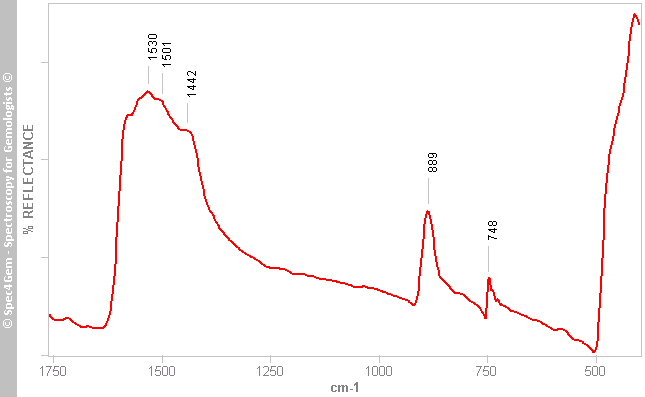
Figure 2. Infrared reflectance spectrum of the sliced and polished chip. Unambiguously, the material is a carbonate from the calcite group, the 748 cm-1 band indicating magnesite.
UV-VIS-NIR spectroscopy:
The same polished slice, thin enough to let it transmit some light is used to acquire the UV-Vis-NIR spectrum.
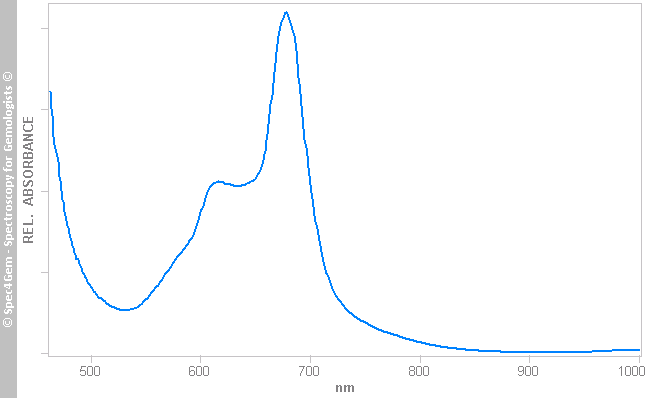
Figure 3. Absorption spectrum of the sliced and polished chip in the Vis-Nir range. The transmission window centered around 530 nm associated with a moderate absorption in the yellow gives the yellowish green color.
The UV-Vis-NIR spectrum of the polished slice of the 'gaspeite' chip (figure 3) shows a strong absorption from the blue-green towards the UV. The orange red is also absorbed lettting a transmission window around 530 nm associated with a moderate absorption in the yellow. This absorption pattern gives the apple-green (yellowish green) color.
Gaspeite is mostly a nickel (Ni) carbonate owing its color to that transition metal. Nickel can be accompanied by Fe and Mg if the gaspeite is a Ferro- magnesian- gaspeite (note that the end member MgCO3 is magnesite). Anyway the Ni spectrum pattern is different of that of the sample, both have a transmission window in the green but the orange, red and NIR are strongly absorbed up to 800 nm. The Ni reference spectrum is that of a gaspeite from the Paris mine, Widgiemooltha, Kambalda, Australia.
The lack of Ni spectrum pattern in the sample spectrum leads to the fact that the material is not colored by Ni, thus it is most likely not gaspeite material or if it was one, it would be an unusual one. This is consistent with the IR reflectance spectroscopy that let foresee magnesite. Could this material be a dyed magnesite ?
Photoluminescence spectroscopy:
The same polished slice was used to check if the material is subject to luminescence while exposed to UV. An excitation source at 405 nm produces a green photoluminescence resulting of a single emission peak centered at 532 nm (figure 4).
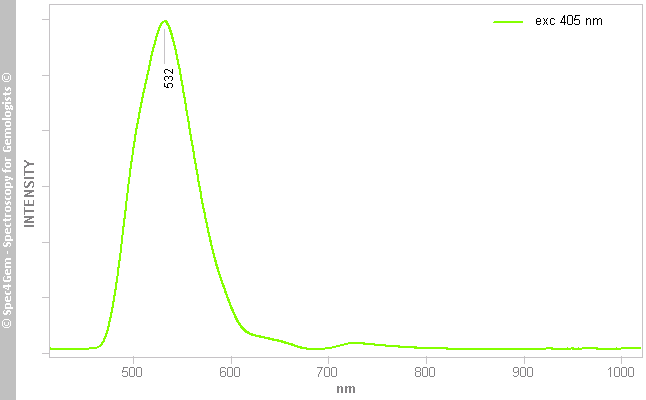 Figure 4: Photoluminescence spectrum of the sliced and polished chip excited with a 405 nm laser source. Luminescence is reduced to a single emission peak centered at 532 nm.
Gaspeite is not known to produce any luminescence while excited by UV. The luminescence observed with the sample is thus unusual, suspecting a luminescence produced by some organic dye.
Since this study, the same luminescence has been observed in a green turquoise with evidences of filling and dying, please read Yellowish-green Turquoise reportedly from Turkmenistan.
Conclusion:
The results of the study are:
- IR reflectance spectroscopy identifies magnesite with a doubt because separating magnesite from gaspeite relies on a band difference of only 2 cm-1.
- UV-Vis-NIR spectroscopy does not reveal Ni in the material, that is the main metal element of the gaspeite (Ni(Fe, Mg)CO3).
- Photoluminescence to UV reveals an unusual green luminescence.
- The material is sometimes spotted with tiny blue dots.
All the results are consistent together and yield to the conclusion that the chips are a gaspeite imitation made of dyed magnesite.