
The turquoise is usually sky blue (most desirable as a gemstone), blue, blue green. The green turquoise is rather uncommon and the color is mostly 'strongly bluish green'. The stone is sold as a natural green turquoise reportedly from Turkmenistan where green turquoise is known. The color is unusual, the color is bluish-green to yellowish-green. However, under the sunlight, the stone becomes very attractive with a 'vivid yellowish-green'. To the unaided eye, the color is mostly uniform but if observed with the 10x lens, some areas are darker, some are lighter and the fractures are always yellowish-green to greenish-yellow. Some black inclusions are present as well as some small caveats on the side of the cab. The difference of color in the fractures is suspect and the slight 'color-shift' from bluish-green to yellowish-green is unusual for a turquoise. A quick check with a 405 nm laser pointer makes the stone strongly glow, the resulting color is somewhat bluish-white but not green. The color is unlikely the color of luminescence but the combination of the light of the laser pointer and the light of the stone luminescence. Anyway this is consistent with the fact the stone is light sensitive, especially UV sensitive.
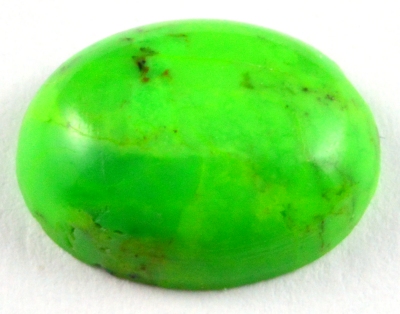 Figure 1. The 1.46 ct yellowish green turquoise
| Shape | oval cab |
| Size | 10.1 x 8.1 x 3.0 mm |
| Color | inhomogeneous yellowish-green (figure 2b) / bluish-green with yellowish 'stain' surrounding the fractures (figure 2a) |
| Lustre | dull to waxy, possibly sub-vitreous |
| Weight | 1.65 ct |
| SG | 2.29 |
| SWUV | greenish-yellow in the fractures, inert everywhere else |
| LWUV | strong yellowish-green all other the stone with a stronger phenomenon in the fractures (figure 3) |
Table 1. Observational and measured properties
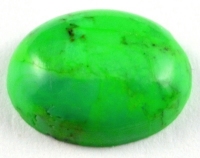 Figure 2a. The color of the stone exposed to 6500°K light with filtered UV is mostly bluish-green with yellowish-green concentrating in and around the fractures.
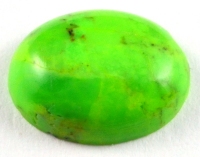 Figure 2b. The color of the stone exposed to natural daylight (sunlight) is mostly yellowish-green with yellow concentrating in and around the fractures.
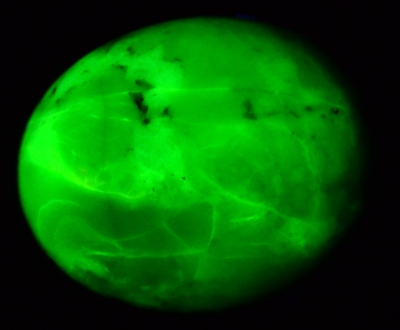 Figure 3. Exposed to long-wave UV, the stone 'glows' strong green. The luminescence is even more intense in the fractures and their surroundings than in the rest of the stone.
Infrared reflectance spectroscopy:
The infrared reflectance spectrum was acquired from the top of the cab where fractures are also present. The result (figure 4) is a typical reflectance spectrum of natural turquoise showing bands with their assignment (Celka et al. 2015 [3]):
- 725 and 785 cm-1 - libration of water
- 831, 899 and 1008 cm-1 - δ Al-OH and/or δ Cu-OH
- 1052 cm-1 - γ PO43- symmetric stretching
- 1112, 1158 and 1194 cm-1 - γ PO43- antisymmetric stretching
The increasing reflectance starting around 1250 cm-1 is likely the result of the overtones of the recombination bands. Two more features are also present in the water area (1600 cm-1) and CO area (1700 cm-1). The band around 1590 cm-1 is likely that of the CH3 bending (Moe et al., 2007 [1]) or that of the δ H2O bending (Celka et al. 2015 [3]) or perhaps both. The 1725 cm-1 band is consistent with the carbon-oxygen double bonds C=O stretching. Anyhow, those two features are always associated with polymers in turquoise mainly used for stabilizing the material, usually colorless but here colored yellowish-green.
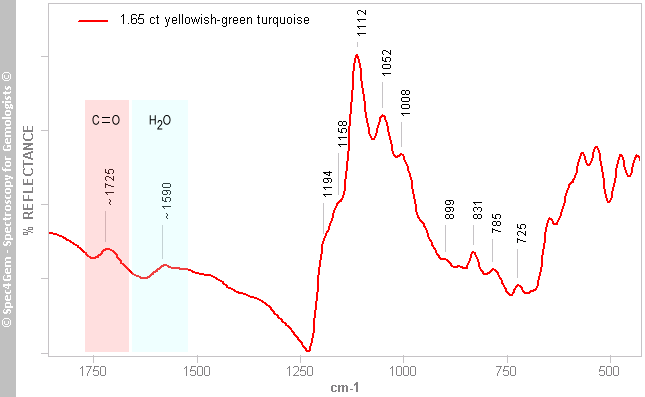 Figure 4. Infrared reflectance spectrum of the top of the cab, typical of natural turquoise (725, 785, 831, 899, 1008, 1052, 1112, 1158 and 1194 cm-1), shows additional features in the 1500-1800 cm-1 range.
UV-VIS-NIR spectroscopy:
Since the material is opaque, getting a transparent or semi-transparent slice would required to build a thin section, destroying the cab.
Photoluminescence spectroscopy:
Turquoise is not known to respond to UV light except for some bluish-green turquoise from Uzbekistan showing a bluish-green luminescence because of UO2-. The studied sample shows some responses to artificial UV lights (both LWUV and SWUV) as well as to the natural daylight.
While exposed to the light of a 405 nm laser source, the stone strongly glows greenish-yellow. The corresponding photoluminescence spectrum is shown in figure 5. The photoluminescence is resumed to what looks like a very strong single emission peak centered to 536 nm across the green and yellow spectral regions. This emission explains the color of the stone while exposed to natural daylight or rich long-wave UV lights. The response to long-wave UV is so strong that natural daylight has enough UV energies to excite the luminescence which is visible without any additional UV source. The observed 'color-shift' is not a true color-shift but just a color modification caused by the addition of the luminescence color to the base color of the material.
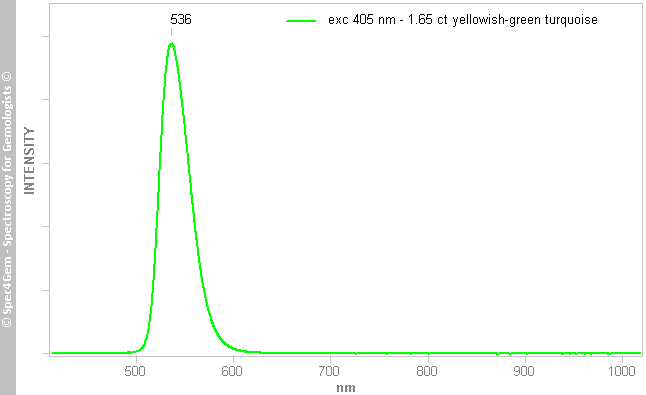 Figure 5. Photoluminescence spectrum
The photoluminescence is attributed to the dyed incorporated in the polymers but the real cause is not yet identified. Similar luminescence was observed in the gaspeite imitation made of yellowish-green dyed magnesite.
Discussion:
Under artificial and natural daylight, the stone does not exhibit the same color, the natural daylight makes it yellowish-green. With the 10x lens, the fractures and fractures fillings are yellowish. Such simple observations rose some doubts about the real nature of the stone and its origins. Classical gemology with UV lamps did the same. The infrared reflectance spectroscopy confirmed the natural turquoise material with the existence of some polymers (1725 cm-1 band). The photoluminescence confirmed the stone is dyed with a strongly yellowish-green luminescent dye, the dye being incorporated within the polymers used to stabilize or aggregate the turquoise.
[1] Moe K.S., Moses T.M., Johnson P. Polymer-impregnated turquoise. Gems & Gemmology, 2007, Summer, pp. 149–151.
[2] Gagan Choudhary. A new type of composite turquoise. Gems & Gemmology, 2010, Summer, pp. 106–113.
[3] J Celka, J Sejkora, I Macek, R Mailkova, L Wang, R Scholz, Y Xi; Raman and infrared spectroscopic study of Turquoise Minerals. Spectrochimica Acta Part A: Molecular and Biomoleculal Spectroscopy, 2015, pp. 173–182.