
The vibrant (vivid) color of the 0.83 ct emerald presented in figure 1 has been scheming for an emerald coming out the new Kenticha deposit in south of Ethiopia. Such colors are often found in Cr/V emerald with very low or no iron content. Ethiopian emeralds from all existing deposits known to date, are schist emeralds (Type-II emerald). They all contain some iron, especially in Fe2+ form giving a characteristic UV-Vis spectrum with a rather strong band around 820 nm. This cut stone is going to make an interesting study sample.
The stone is far from a well cut stone, there is an important window. The inclusion scene should be of interest as biotite inclusions could be present, as found in some of the ethiopian emeralds.
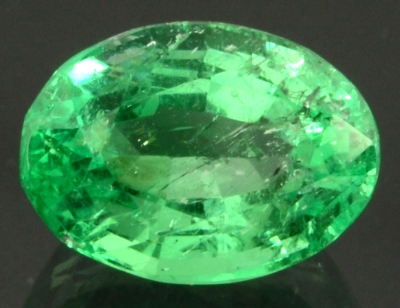 Figure 1. The 0.83 ct vivid slightly-bluish green emerald was
reported from Kenticha, Ethiopia.
| Shape | oval |
| Size | 7.1 x 5.1 x 3.9 mm |
| Color | vivid slightly-bluish green |
| Lustre | vitreous |
| Weight | 0.83 ct |
| SG | (2.65) [Dubuluk deposit: 2.72 [1], Kenticha and Dermi: 2.73 [2]] |
| RI | 1.571-1.579 [3.60ct ethiopian crystal: 1.580-1.588, Dubuluk deposit: 1.578-1.585 [1], Kenticha and Dermi deposit: 1.581-1.589 [2]] |
| DR | 0.008 Uniaxial negative |
| Pleochroism | weak: bluish-green / yellowish-green |
| Polariscope / Conoscope | uniaxial figure observed down the C-axis which is at 30° of the table and || length of the stone |
| SWUV | inert |
| LWUV | inert but glows red with a 405 nm laser beam |
| Magnetic susceptibility N52 | inert |
| Chelsea filter | pink |
Table 1. Observational and measured properties
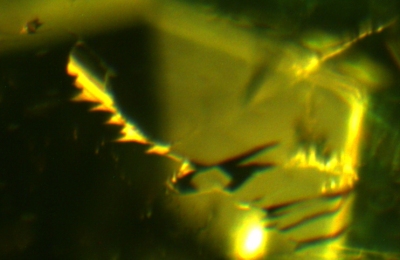 Figure 2a. Highly reflective jagged inclusions seen in darkfield. They
do not show any particular color, they do not reach the surface.
Darkfield, FOV: 1.4 mm.
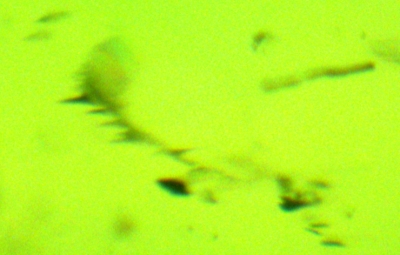 Figure 2b. The same inclusion as in figure 2a but in transmitted light.
Transmitted light, FOV: 1.4mm.
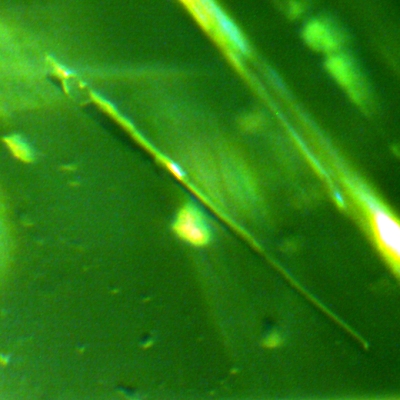 Figure 3a. A needle-like inclusion, it seems to include a transparent
bubble at the larger end and an elongated opaque solid/liquid/gaz
inclusion which is reflective in this darkfield light configuration. The all
primary inclusion seems to be filled.
Darkfield, FOV: 0.4 mm.
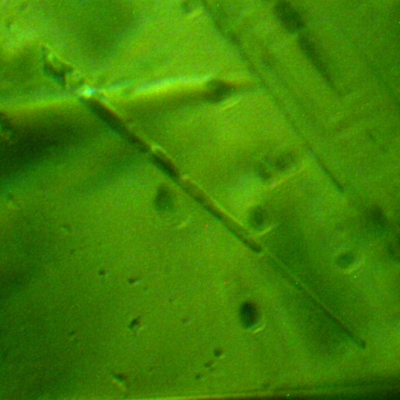 Figure 3b. The same needle-like inclusion as in figure 2a but the
darkfield light is slightly modified.
Darkfield, FOV: 0.4 mm.
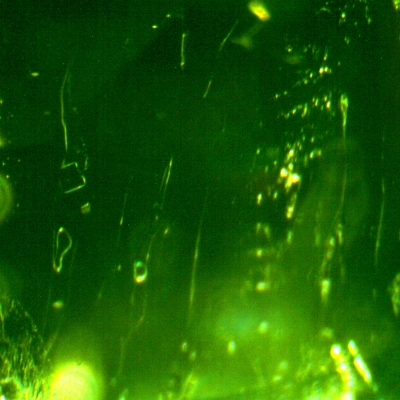 Figure 4. Three phase inclusions. Left, a solid and transparent cubic
crystal and an elongated bubble within a stretched cavity with sharp
ends. Center, an elongated bubble and a transparent cubic crystal.
Darkfield, FOV: 1.20 mm.
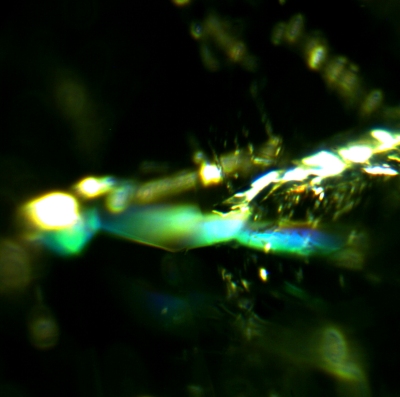 Figure 5. Light interference in an empty fissure. Not to be mistaken
with blue flashes of resin/oil fillings.
Darkfield, FOV: 1.25 mm.
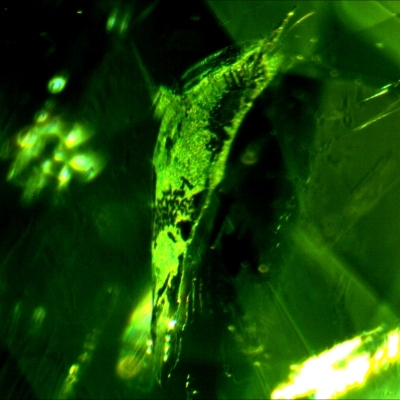 Figure 6a. Dendritic large white fissure, likely filled with oil. It includes
two dendritic black inclusion, can be either a dendritic pyrolusite or
some dried oil.
Darkfield, FOV: 1.60 mm.
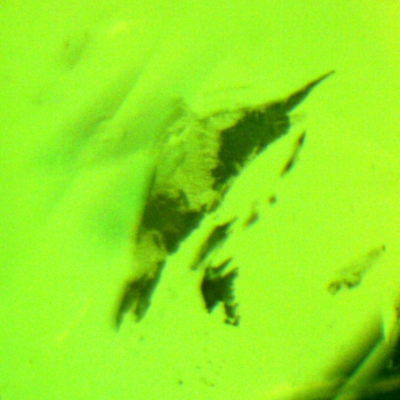 Figure 6b. The same dendritic inclusion scene as in figure 6a but
seen in transmitted light. Middle of the scene, two jagged shaped
inclusions can be observed.
Transmitted light, FOV: 1.9 mm.
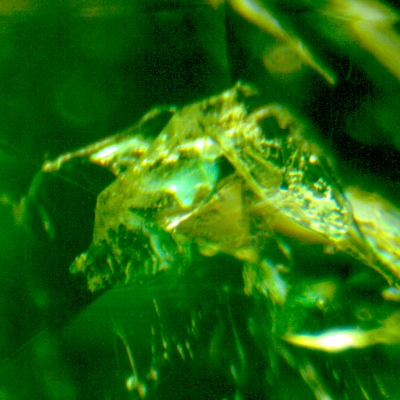 Figure 7. A surface-reaching fracture showing a milky green color,
 the phenomenon is well-known in oiled emerald.
Darkfield, FOV: 2.0 mm.
No biotite inclusion was found. Multiphase inclusions do exist but in limited quantity. The few ones are elongated ones (figure 4) and they are not 'blocky' ones as generally seen in ethiopian emeralds. Highly reflective jagged inclusions can be observed (figures 2a, 2b). Many fissures are present in the stone with different properties: empty fissure with light interference colors (figure 5), filled fissure with oil showing dendritic aspect, especially dark ones that can be confused with dendritic pyrolusite inclusion (figures 6a, 6b), filled reaching-surface fissure showing green colors (figure 7). Very few tiny needle-like inclusions (figures 3a, 3b) are seen, the field of view is only 0.4 mm. This emerald has undoubtedly been enhanced by fissure filling (likely oil). Dendritic black pyrolusite can be excluded since it is surrounded by oil in all the fissure and it is likely dryed oil. This would suggest the filling is not so recent.
Infrared reflectance spectroscopy:
The IR reflectance spectrum (figure 8) was acquired from the table. Since the table is oriented in a plan inclined about 30° from the C-axis, so the spectrum is very close to that of a (1010) face or (0110) or in between of a hexagonal crystal. Anyway, spectra in such direction differs significantly from that in the (0001) face but the bands positions remains the same, only the intensity vary. The spectrum shows a characteristic beryl reflectance spectrum. The bands positions may vary from one emerald to another, here the bands are in the high end of the varying range. For example, the last main band towards high energies is as height as 1279 cm-1. Comparatively, the same band of the 3.60 ct ethiopian emerald crystal is located at 1267 cm-1.
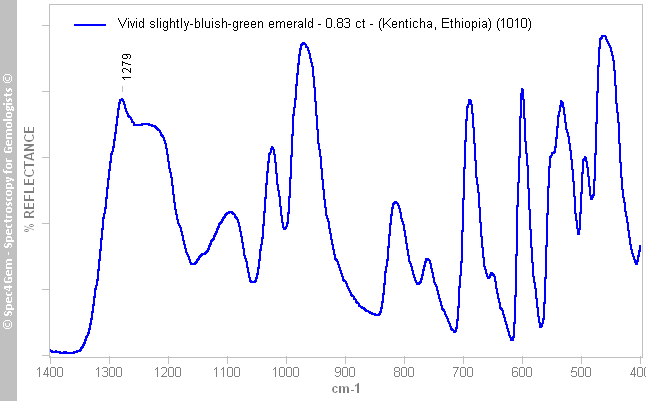 Figure 8. The IR reflectance spectrum of this 0.83 ct emerald acquired from the table (approximately a (1010) crystal face)) shows a characteristic beryl reflectance spectrum. The bands positions may vary from one emerald to another, here the bands are in the high end of the varying range. For example, the last main bands towards high energies is as height as 1279 cm-1. Comparatively, the same band of the 3.60 ct ethiopian emerald crystal is located at 1267 cm-1.
 UV-VIS-NIR spectroscopy:
The UV-Vis spectra (figure 9, E_|_C in dark-green and E||C in light-green) of this 0.83 ct emerald show two main bands at 432 and 610 nm. Some weaker features at 477 nm, then at 642, 663, 681, 684 nm and then at 836, 884 and 958 nm are present. The 370 nm is related to Fe3+ but in this case it is mostly 'inexistent'. The 432, 477, 610, 642, 663, 681 and 684 nm features are attributed to Cr3+ and that at 958 nm to H2O. The 836 and 864 nm features are not definetly explained but they are possibly related to Cr3+ as well. Vanadium could be present although its band, usually as a shoulder at 390 nm, is not visible.
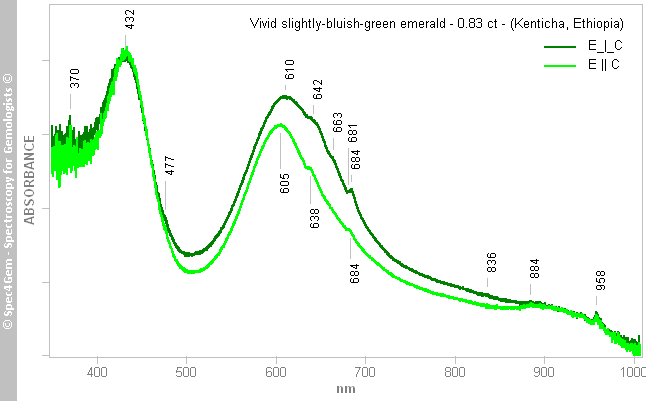 Figure 9. The UV-Vis spectra (E_|_C in dark-green and E||C in light-green) of this 0.83 ct emerald show two main bands at 432 and 610 nm. Some weaker features at 477 nm, then at 642, 663, 681, 684 nm and then at 836, 884 and 958 nm are present. The 370 nm is related to Fe3+ but in this case it is mostly 'inexistent'. The 432, 477, 610, 642, 663, 681 and 684 nm features are attributed to Cr3+ and that at 958 nm to H2O. The 836 and 864 nm features are not definitely explained but they are possibly related to Cr3+ as well. Vanadium could be present although its band, usually as a shoulder at 390 nm is not visible.
This emerald is colored by Cr3+ without any trace of Fe2+ and very few Fe3+, it can be considered as a chromium emerald. This is not consistent with the ethiopian merald data published to date and the data of the 3.60 ct ethiopian emerald crystal report.
Photoluminescence spectroscopy:
Although this emerald being inert to SWUV and LWUV using UV cabinet, it strongly glows red with a 405 nm laser. Two photoluminescence spectra (figure 10) were acquired with such a laser, one (red spectrum) where the laser beam was almost parallel to the C-axis and other one (purple spectra) where the laser beam was perpendicular to the C-axis.The beam || C spectrum was shifted for clarity.
The two spectra present the same emission pattern, characteric of emerald luminescence. As for other emerald, the E||C spectrum has a prominent 687 nm emission peak compared to the E_|_C spectrum. This 687 nm emission is in fact a doublet which cannot be realy resolved with the spectrophotometer used in this report. This emission is ascribed to Cr3+ in beryl, precisely to the Cr3+ R-lines. Its position varies very slightly whether the emerald is of Type-I (non-schist origin), Type-II (schist origin) or even synthetic origin (flux & hydrothermal). The main emission at 717 nm is related to Cr3+ as well.
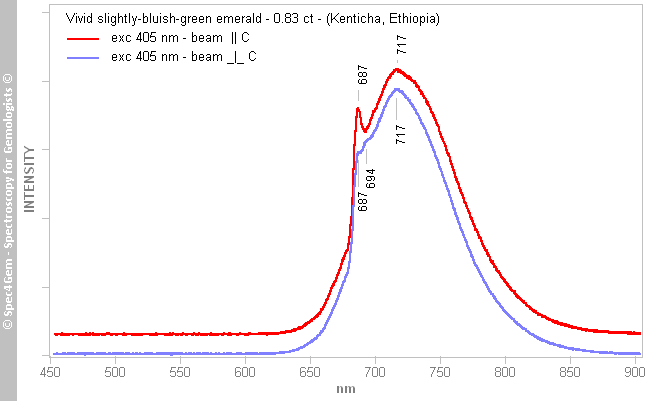 Figure 10. Photoluminescence spectra obtained with a 405 nm laser whose beam was set to hit the stone in two directions (red spectrum: || C, purple spectrum: _|_C). They show a characteristic emission of Cr3+ in beryl (emerald) with the Cr3+ R-Lines at 687 nm and the main Cr3+ at 717 nm.
Conclusion:
Classical gemology and spectroscopic data are undoubtly consitent with that of emerald (beryl). The refractive indexes are in the low end range for emerald, indicating a low iron content, that is confirmed by UV-Vis spectroscopy since the spectrum is mainly related to Cr3+ without any indication of Fe2+. The lack of iron (Fe2+) is not consistent for ethiopian schist emeralds. Inclusion scene is not similar to that encountered in the ethiopian emeralds: biotite and blocky multiphase inclusion are missing.
This emerald has been enhanced with oil filling (likely for already a rather long time since oil is dyed out).
Unless there is an improbable undisclosed chromium-bearing emerald deposit in southern Ethiopia, this stone originates very likely from another locality. To confirm that statement, LA-ICP-QMS quantitative trace-element composition analysis could be used.
From the optical properties, the most suitable location are: Colombia (Chivor, Gachala), Mozambique (Musakashi), Brazil (Taua Ceara). Chivor could be the right one bacause of its low SG range (2.65-2.70). Anyway it is impossible to definitly conclude.
[1] Emerald from Ethiopia, P. Cevallos, W. B.(Skip) S. and A. U. Falster, Gems & Gemmology, 2012, Fall, pp. 219-220
[2] A new discovery of emeralds from Ethiopia, N. Renfro, Z. Sun, M. Nemeth, W. Vertriest, V. Raynaud and V. Weeramonkhonlert, Gems & Gemmology, 2017, Spring, pp. 114-116
[3] New Production of Emerald from Ethiopia, B. M. Laurs, E. Strack, Journal of Gemmology, 2017, volume 35, No.5, pp. 386–387