
The Peñas Blancas mining area is located near the Mun. de San Pablo de Borbur, in the Vasquez-Yacopí Mining District, Boyacá Department, Colombia. It is on the northern edge of the western emerald bearing belt, also known as the the Boyaca belt, north of Muzo. A few of high quality fluorite has been mined there for over the past 2 decades. The material was described in 2000 in the Revue de Gemmologie A.F.G. by P. Vuillet [1].
The fluorite from this locality occurs as cubic crystals, sometime as octahedron, as much as 40 cm on edge! Most are colorless and a few are pink, and sometime they have emerald green 'phantoms' (globs) in the center or corner of the crystal which led to the material being called chrome fluorite. In the trade, many believe the fluorite is colored by chromium because chromium is the chromophore that causes the green color in emeralds of that locality.
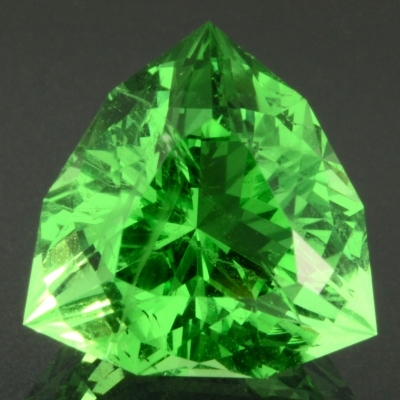 Figure 1. This 5.55 ct slightly-bluish-green fluorite comes out of
the Peñas Blancas mining area in Colombia.
A sample of this green fluorite material is the 5.55 ct slightly-bluish-green fluorite gemstone shown in figure 1. The stone is included but this does not really influence the light return since the inclusion plane was oriented perpendicular to the table. A great job by the cutter, the picture does not do justice to the beauty of this stone!
| Shape | a kind of trillion |
| Size | 10.9 x 10.9 x 10.9 x 8.5 mm |
| Color | slightly-bluish-green (very bright slightly-bluish-green in cool white light, especially with LED lights, strongly grayish-bluish-green in warm white light) |
| Lustre | dull vitreous to vitreous |
| Weight | 5.55 ct |
| SG | 3.16 [P. Vuillet [1]: 3.15, litterature: 3.09 - 3.25] |
| RI | 1.436 [P. Vuillet [1]: 1.429, litterature: 1.428 - 1.436] |
| DR | - |
| Pleochroism | none, not applicable |
| Polariscope / Conoscope | remains dark through 360° rotation → isotropic |
| SWUV | weak violet-blue |
| LWUV | strong violet-blue |
| Magnetic susceptibility | N52: diamagnetic |
| Chelsea filter | light pink |
Table 1. Observational and measured properties
UV-VIS-NIR spectroscopy:
The UV-Vis-NIR spectrum was acquired with the light path crossing the stone from its culet to its table. Anyway the stone being isotropic, neither the stone's orientation nor the light polarization influence the absorption spectrum.
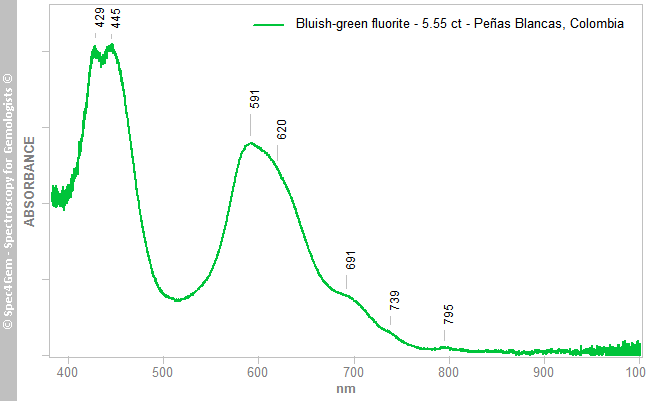 Figure 2. The UV-Vis-NIR spectrum of this fluorite shows two strong absorption groups, one with two bands at 429 and 445 nm and the other one with the band at 591 nm and its strong shoulder at 620 nm. Additional weak bands are also present at 691, 739 and 795 nm. The stone owes its green color to the two absorption groups creating the transmission window around 510-520 nm in the green spectral range. This absorption pattern is ascribed to Sm3+ [1][2].
The UV-Vis-NIR spectrum (figure 2) of this fluorite shows two strong absorption groups, one with two bands at 429 and 445 nm and the other one with the band at 591 nm and its strong shoulder at 620 nm. The later group is followed in the red and near infrared by additional comparatively weak bands at 691, 739 and 795 nm. The stone owes its green color to the two absorption groups at 429, 445 and 591, 620 nm creating the transmission window around 510-520 nm in the green spectral range. This absorption pattern is ascribed to Sm3+ [1][2]. This spectrum observed with an hand-held spectroscope can be confused with that of Cr3+-bearing emeralds with its two prominent bands in the visible range around 435 and 610 nm. The stone is also light-pink viewed with the Chelsea filter. These two observations combined with the fact such fluorite are found in the vicinity of the emerald's mining area led many people to the misinterpretation that these fluorite are chrome-fluorite! Samarium (Sm3+) impurities are responsible of this so characteristic color.
Photoluminescence spectroscopy:
Two photoluminescence spectra were acquired, one with a 377 nm source with a rather low throughput and the other one with a powerful 405 nm laser that requires to use a longpass filter to prevent the spectrometer to be dazzled and let it collect the interesting low signals.
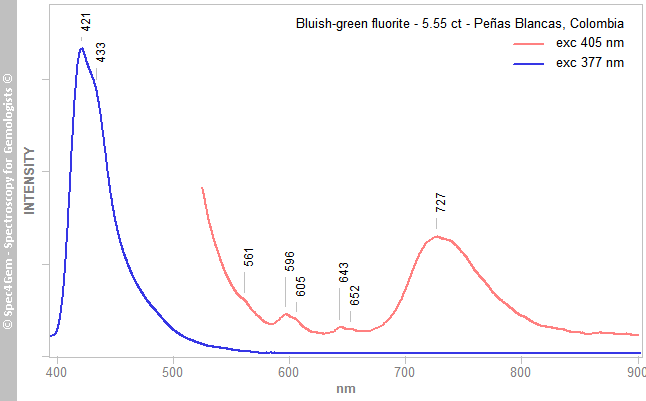 Figure 3. The photoluminescence spectra of this colombian fluorite show strong emissions at 421 and 433 nm in the violet-blue, attributed to Eu2+ [3][4], that is quite common in many fluorites. The 405 nm excitation spectrum (red) is shifted and scaled because intensities are so weak compared to the Eu2+ emission peak. The 561, 596, 605 and 643 nm emission peaks are ascribed to Sm3+ [3][4], the 596 nm one can be ascribed to Eu2+ [3][4] as well. The 652 nm emission is possibly connected to Sm2+ [3][4] and the 727-735 nm emissions are likely the combined emissions connected to the M-center and Sm2+ [3][4].
The photoluminescence spectra (figure 3) of this colombian fluorite show strong emissions at 421 and 433 nm in the violet-blue, attributed to Eu2+ [3][4], that is rather common in many fluorites. The 405 nm excitation spectrum (red) is shifted and scaled because the intensities of the other features are so weak compared to that of the Eu2+ emission peak. The 561, 596, 605 and 643 nm emission peaks are ascribed to Sm3+ [3][4], the 596 nm one can be ascribed to Eu2+ [3][4] as well. The 652 nm emission is possibly connected to Sm2+ [3][4] and the 727-735 nm emissions are likely combined emissions connected to the M-center and Sm2+ [3][4].
Conclusion:
This green fluorite material is available in the gem trade from time to time even if it is known for about 2 decades. Since the beginning, the material is known to be colored by the Sm3+ REE as shown by the UV-Vis spectrum and confirmed by the photoluminescence spectrum. The later statement defeats the popular belief that the Colombian fluorite is colored by chrome as for emeralds.
[1] La fluorite verte de Penas Blanca, P. Vuillet à Ciles, Revue de Gemmologie A.F.G., N°140, Juillet 2000, pp. 21-25
[2] Fluorite Visible Spectra - List of Visible Data Files on the Caltech Mineral Spectroscopy Server
[3] Modern Luminescence Spectroscopy of Minerals and Materials, 2nd Edition, M. Gaft, R. Reisfeld, G. Panczer, Springer Editor, ISBN: 9783319247632
[4] Luminescent Spectra of Minerals, Boris S. Gorobets and Alexandre A. Rogojine, Moscow, 2002, ISBN: 5901837053