
Available for the first time during the 2009 edition of the Sainte-Marie-Aux-Mines Mineral Show, unusual orange kyanite attracted collectors. The faceted gemstones weigh 0.70 ct to almost 1.00 ct. The material comes from Nani, Loliondo region in Tanzania.
The material hosts lot a tiny reddish inclusions evenly distributed. The orange color is homogeneous with a very slightly brownish tint (very slightly unsaturated orange).
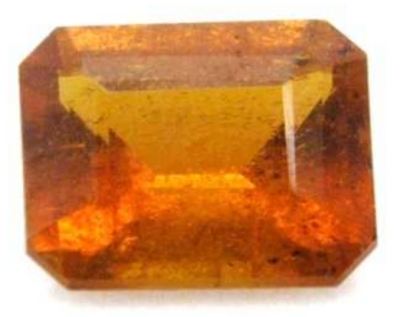 Figure 1. Rare 1.00 ct orange kyanite reportedly from Nani, Loliondo,
Tanzania.
| Shape | 'emerald cut' |
| Size |
7.3 x 4.4 x 2.9 mm |
| Color | orange (very slightly brownish-orange) |
| Lustre | sub-vitreous |
| Weight | 1.00 ct |
| SG | 3.67 |
| RI | 1.717 - 1.734 |
| DR | 0.017 B+ |
| Pleochroism |
orangish-yellow / light-yellow |
| Polariscope / Conoscope | light/dark 4 times / 360° |
| SWUV | inert |
| LWUV | inert |
| Magnetic susceptibility | weak with N52 |
Table 1. Observational and measured properties
Infrared reflectance spectroscopy:
The IR reflectance spectrum (figure 2), acquired from the table, exhibits the characteristic spectrum of kyanite specie.
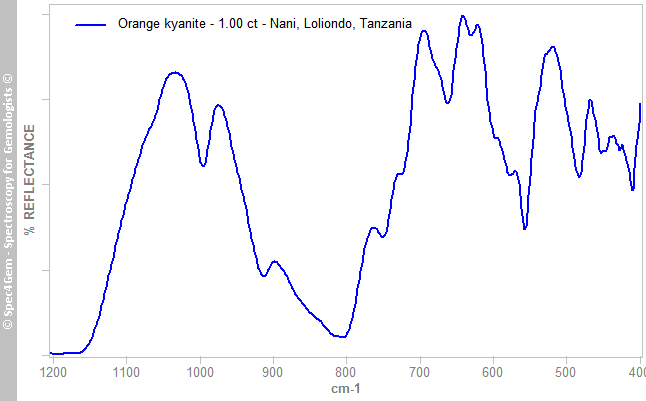 Figure 2. IR reflectance spectrum of the 1.00 ct orange kyanite from Nani, Loliondo, Tanzania, acquired from the table, exhibits the characteristic spectrum of kyanite specie.
UV-VIS-NIR spectroscopy:
The UV-Vis-NIR absorption spectrum (figure 3) was acquired with the light path perpendicular to the table with the light entering the pavilion.
The unpolarized UV-Vis-NIR absorption spectrum shows a major band around 475 nm and a comparatively weaker but large band around 995 nm. Some additional weak features are present at 380, 554, 691 and 710 nm.
The main band centered around 475 nm is resulting of the combination of several bands that can be made out around 445, 475 and 490 nm. Fe3+-kyanite (green kaynites) usually show a 'doublet' at 370 and 380 nm and another one at 435 and 445 nm, with sometime a quite weak and large band centered around 620 nm. With this orange kyanite, the 380 and 445 nm bands are present but they are weaker than the main features at 475 and 490 nm.
anat but exhibits features at 436, 447, 468, and 490 nm, all combined producing a strong band centered approximately at 450 nm. The rising edge towards UV (410 - 390 nm) suggests the 370-380 nm bands usually observed in Fe3+-kyanite. There is a weak feature at 555 nm followed by a weak and large band around 620 nm in the NIR direction of the spectrum. Two very common weak bands are also present at 691 and 710 nm as observed in most of kyanites. NIR region shows a moderately strong and very wide band (FWHM > 200 nm) centered around 1000 nm. The 380, 436, 447 and 620 nm features are related to Fe3+ as for green kyanites (Faye and Nickel, 1969)[2], (Parkin et al., 1977)[1]. The 691 and 710 nm are unambiguously attributed to Cr3+. The rare features at 468, 490, 555 and ~1000 nm are possibly related to Mn2+ as for orange kyanite mined in Loliondo region in Tanzania.
The extra absorption in the 460 - 550 nm region that does not exist in the green kyanite spectra explains the yellow color.
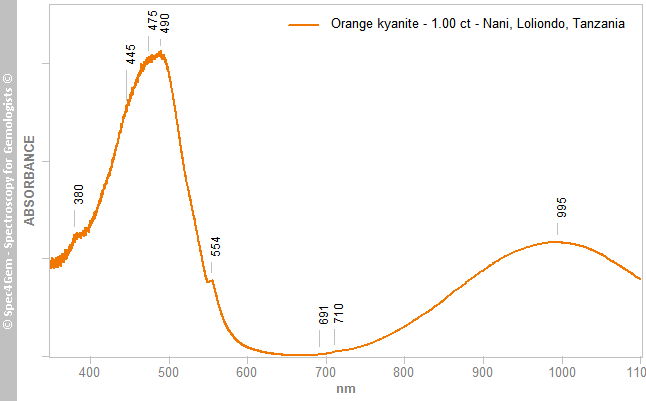 Figure 3. Unpolarized UV-Vis-NIR absorption spectrum of the 1.00 ct orange kyanite from Nani, Loliondo, Tanzania exhibiting features at 380, 445 nm related to Fe3+, at 475, 490, 554 and 995 nm attributed to Mn2+, and at 691 and 710 nm the common Cr3+ features.
Photoluminescence spectroscopy:
Although the gemstone is inert under the SW and LW lamps, a 405 nm laser pointer induce red luminescence. The photoluminescence spectrum (figure 4) excited with a 405 nm laser was acquired without any specific orientation.
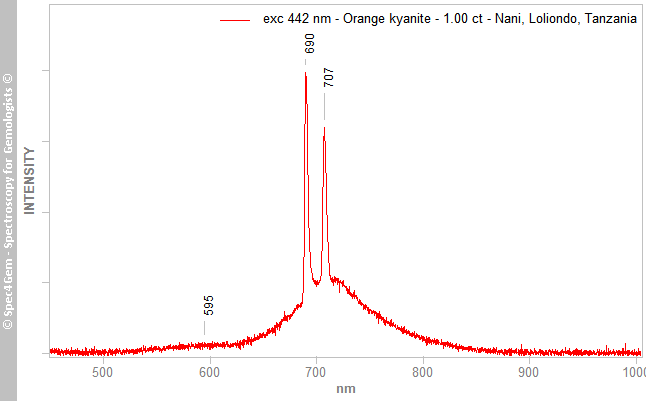 Figure 4. Photoluminescence spectrum of the 1.00 ct orange kyanite from Nani, Loliondo, Tanzania, showing the Cr3+ R2 & R1 lines respectively at 690 and 707 nm. Unlike most of kyanites, the spectrum shows a very weak and large emission around 595 nm region, possibly attributed to Mn2+.
This yellow kyanite shows a moderate red luminescence attributed to the R2 & R1 lines of Cr3+ respectively at 689 and 707 nm (Gaft et al.)[5]. Unlike most of kyanites, the spectrum shows another emission center in the 575 nm region, rather weak compared to Cr3+ emission centers. Such emission center is consistent with Mn2+ emission centers observed in many minerals, as well as it is consistent with the Mn2+ absorptions features (excitation features) observed in the UV-Vis-NIR spectrum of figure 4.
Conclusion:
The yellow color of this unusual 7.69 ct yellow kyanite is due to Fe3+ and Mn2+ ions.
[1] Mineralogical Applications of Crystal Field Theory, R. G. Burns, 2005, ISBN: 0521017858 | 978-0521017855
[2] On the origin of colour and pleohroism of kyanite, G. H. Faye, E. H. Nickel, The Canadian Mineralogist, Vol 30, No 35, 1969
[3] Blue colour-changing kyanite from East Africa, G. Bosshart et al., Journal of Gemmology, Vol. 18, No. 3, pp. 205–212
[4] Kyanite Visible Spectra - List of Visible Data Files on the Caltech Mineral Spectroscopy Server
[5] Modern Luminescence Spectroscopy of Minerals and Materials, 2nd Edition, M. Gaft, R. Reisfeld, G. Panczer, Springer Editor, ISBN: 9783319247632