

Massive yellow cancrinite from the Kola Pennisula, Russia
- Details
- Created: Sunday, 07 October 2018 11:58
Cancrinite is sometime found as a gemstone but more commonly as a mineral specimen. It occurs in many colors such as blue, grayish-green, yellow, orange and reddish. Prismatic crystals are rather rare, it often forms large masses of uniformly crystals. The cancrinite belongs to the cancrinite group which is part of the feldspathoid group. It is a silicate with a special feature since the crystal lattice also includes CO32- carbonate and to a lesser extend SO42- sulfate ions. If SO42- ions content is higher than CO32- ones and some potassium is present, the material is then vishnevite, the cancrinite analogue, also known as the sulfatic cancrinite.
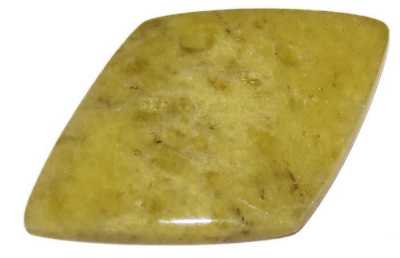 Figure 1. The 43.94 ct light-yellow cancrinite cab shows the massive
structure of the material.
| Shape | losange cab |
| Size | 51 x 33 x 3 mm |
| Color | pale yellow |
| Lustre | vitreous2.32-2.42 |
| Weight | 43.94 ct |
| SG | 2.12 [cancrinite: 2.42-2.51, vishnevite: 2.32-2.42], rather low for this mineral specie but might be due to the massive structure |
| RI | ~1.51 [cancrinite: 1.507-1528, vishnevite: 1.488-1.507] |
| DR | - [cancrinite: 0.012-0.025, vishnevite: 0.002-0.012] |
| Pleochroism | - |
| Polariscope / Conoscope | - |
| SWUV | inert |
| LWUV | inert |
| Magnetic susceptibility N52 | diamagnetic |
| Chelsea filter | pale yellow |
Table 1. Observational and measured properties
Infrared reflectance spectroscopy:
Several spectra were acquired from the top of the cab to avoid a poor material determination because of the massive structure which does not look like homogeneous. All collected spectra gave the same spectrum pattern as shown in figure 2. The weak bands around 1500 cm-1 are related to the carbonate ions.
The spectrum is fully comparable to the ATR spectrum of the cancrinite (sample R050352) from Ontorio, Canada [1]. It is also fully comparable to the transmission spectra of many cancrinite spectra described in the Chukanov's 'Infrared spectra of mineral species' book [2].
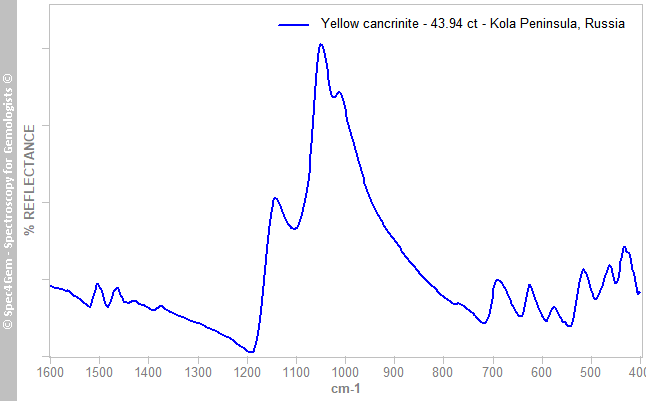 Figure 2. IR reflectance spectroscopy spectrum acquired from the top of the 43.94 ct yellow cancrinite cab.
UV-VIS-NIR spectroscopy:
The material of this cab is not transparent enough to get the light transmitted, thus UV-Vis-NIR absorption spectrum cannot be acquired. It should be given a try with UV-Vis-NIR reflectance.
Photoluminescence spectroscopy:
The material being inert under UV lamps, the 405 nm laser reveals the material is luminescent with an intensity which varies accros the all cab. Some areas show a rather strong pink emission whereas some another are almost inert. Whatever the luminescence intensity is, the emission pattern is always the same as shown in figure 3.
Such characteristic pattern is quite common in sodalite group (hauyne, sodalite, ...) another feldspathoid members. It is attributed to S2- that is consitent with the presence of SO42-. The same emission pattern was described for the vishnevite by Gorobets & Rogojine [3].
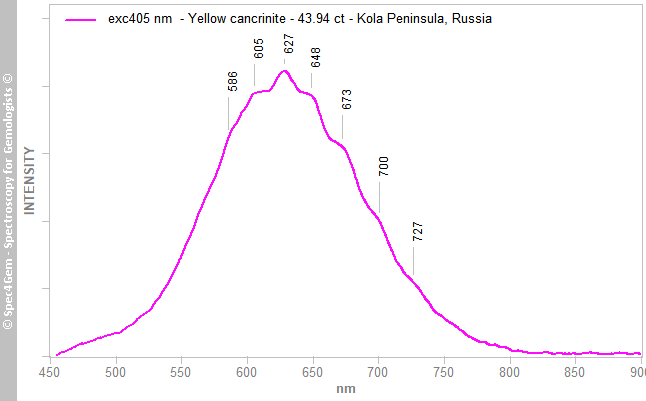 Figure 3. The photoluminescence spectrum of the 43.94 ct light-yellow cancrinite cab shows the emission pattern of S2- resulting in the pink luminescence observed with a 405 nm laser.
 Conclusion:
Again this is an unusual material as a gemstone even if it is quite common in nature. The massive material of this cab is identified as cancrinite by the IR reflectance spectroscopy, which also shows the presence of carbonate. The pink S2- luminescence is consistent with the presence of sulfate.
The question to know if this stone is more a cancrinite than a vishnevite or vice-versa is still pending!
[1] RRUFF database - Cancrinite R050352
[2] Infrared spectra of mineral species, Nikita V. Chukanov, 2014, Springer, ISBN: 978-94-007-7128-4
[3] Luminescent Spectra of Minerals, Boris S. Gorobets and Alexandre A. Rogojine, Moscow, 2002, ISBN: 5901837053